
Why Dubai Businesses Are Quietly Ditching Billboards for Screens Inside Venues
You have seen it a thousand times. A sleek billboard towering over Sheikh Zayed Road. A face. A tagline. A logo. Three seconds of visibility before the car in front moves and the driver’s attention moves with it.
That is the reality of traditional outdoor advertising in Dubai in 2026. Fast, expensive, unmeasurable and — most critically — completely ignored by the very audience it is trying to reach.
Something significant is shifting in how smart Dubai brands allocate their media spend. And understanding why that shift is happening could be the difference between advertising that generates real customers and advertising that simply generates invoices.
The Problem Nobody Talks About With Outdoor Billboards in Dubai
Dubai is one of the most visually saturated advertising environments on the planet. Walk down any commercial street, pass any highway junction, enter any mall entrance, and you are competing against dozens of other brands all screaming for the same three seconds of attention from someone who is either driving, rushing, or actively trying to get somewhere else.
The average outdoor billboard in Dubai delivers what researchers call passive exposure. The viewer is in motion. Their brain is in navigation mode. They are not thinking about insurance plans, supplement brands, dental clinics or lifestyle apps. They are thinking about where they are going.
Traditional billboard advertising was built for a different era, when brand repetition through volume was the only strategy available. Today, it is not the only strategy. And for many categories — health, wellness, finance, lifestyle — it may actually be one of the least effective.
The more important question Dubai advertisers should be asking is not how many people pass my billboard. It is how many people are actually in a receptive mental state when they see my brand.
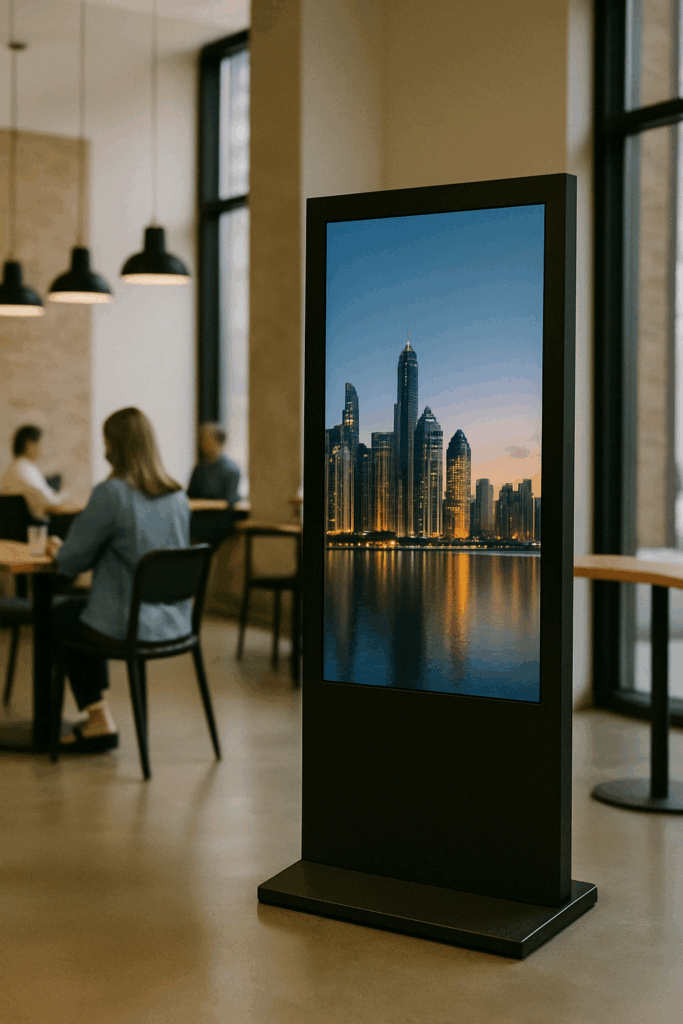
What DOOH Advertising Actually Means — and Why the Indoor Version Matters Most
Digital Out of Home advertising, or DOOH, refers to any digital screen placed in a physical environment outside of a home. That includes roadside LED displays, airport screens, mall displays and — most powerfully — indoor venue screens.
The distinction matters enormously. Outdoor DOOH, even in digital format, still suffers from the same core limitation as traditional billboards. The audience is moving. Dwell time is measured in seconds.
Indoor DOOH is a fundamentally different medium. When a digital screen is placed inside a medical clinic waiting room, a gym changing area, a salon treatment chair or a café dining section, everything changes.
The audience is stationary. They are not going anywhere for fifteen, thirty, sometimes forty five minutes. They have nothing to do except exist in that space — and look at what is in front of them. That screen.
At TheScreen.ae, we operate an indoor screen network across venues in Dubai where this exact dynamic plays out hundreds of times every single day. Real people, captive attention, zero skip rate. Not because the ad forced them — because the environment simply makes looking at the screen the most natural thing to do.
The Psychology Behind Why Indoor Screens Outperform Billboards
There is a concept in advertising psychology called the receptivity window — the period during which a person’s brain is open to new information and persuasion. Outside of this window, even the most brilliant creative work is largely wasted.
Billboards hit people outside their receptivity window almost by definition. A driver making a lane change. A pedestrian checking their phone. A passenger looking at the skyline.
Indoor venue visitors are almost always inside their receptivity window. A patient waiting for their name to be called is not distracted — they are mentally idle and open. A gym member cooling down after a workout is relaxed and receptive. A salon client sitting in a chair for an hour has nowhere else to be and nothing else to compete for their focus.
This is not a minor advantage. It is the entire game.
Recall rates for indoor venue advertising consistently outperform outdoor formats across studies conducted in the UAE and internationally. When a brand appears in a context where the viewer is calm, seated and unoccupied, that brand has a genuine opportunity to make an impression that lasts beyond the screen.
Why Venue Targeting Changes Everything for Dubai Advertisers
Traditional billboards allow for location targeting in the most basic sense. You can put your ad near a hospital, near a gym, near a shopping district. But the people who see it are still passers by, not qualified audience members.
Indoor venue advertising delivers something billboards simply cannot — contextual precision.
When a pharmaceutical brand runs on the screens inside medical clinic waiting rooms in Dubai, it is not guessing who might be health conscious in the general population. It is speaking directly to people who are sitting in a clinic right now, already thinking about health, already in a healthcare mindset. The relevance gap between that context and a roadside billboard is enormous.
When a sports nutrition brand runs inside gyms and fitness centers, the audience is not just demographically likely to be interested. They are physically demonstrating that interest at the exact moment they see the ad. That is not targeting. That is precision.
The same logic applies across every venue category. A beauty or skincare brand inside salons and beauty centers reaches customers who are already spending money on personal appearance. An F&B brand inside cafés and restaurants reaches customers who are already in the mindset of enjoying themselves and being open to discovery.
No billboard, however well positioned, can replicate this.
The Measurement Reality: What You Can Actually Know
One of the persistent frustrations with traditional outdoor advertising in Dubai is attribution. You pay for a billboard on a major route, you run it for a month and then — what? You look at your sales data and try to work out whether it did anything. The answer is almost always inconclusive.
Indoor venue advertising operates within an environment where dwell time, audience volume and venue footfall can be tracked and estimated with real confidence. If a venue receives 400 patients per week and each waits an average of 25 minutes, you have a measurable audience with measurable exposure time. That is a foundation for real accountability.
If you are ready to move beyond guessing and start placing your brand where real attention lives, start your campaign with TheScreen.ae and see how indoor screen advertising compares to what you are currently spending on outdoor formats.
What This Means for Specific Dubai Industries
Health and insurance brands in Dubai have historically over-invested in outdoor formats that reach broad, unqualified audiences. The shift to indoor clinic advertising is not just a trend — it is a structural correction. The audience inside a clinic is the audience. There is no approximation involved.
Fitness brands, supplement companies and wellness platforms face a similar situation. A billboard near a gym catches commuters. A screen inside a gym catches gym members. These are categorically different audiences with categorically different conversion potential.
Lifestyle brands, food delivery platforms, fintech apps and local service businesses all share the same fundamental challenge — they need to reach people who are actually likely to respond. Indoor venue screens solve this in a way that outdoor formats never could.
The Honest Comparison Every Dubai Advertiser Should Make
Before your next outdoor billboard renewal, ask yourself three questions.
How many people who see that billboard are in a mental state to actually absorb my message? What is my real audience, not just the footfall count on that road? And is there a format that delivers the same brand presence to a smaller, more relevant, far more attentive audience for comparable or lower spend?
The answer, for most Dubai brands in 2026, is yes. That format exists. It is indoor digital screen advertising, and it is what TheScreen.ae was built to deliver across a growing venue network in the emirate.
The brands that figure this out early will not just save money. They will reach customers that outdoor advertising was never going to convert.
Frequently Asked Questions
Is DOOH advertising more expensive than traditional billboards in Dubai?
Not necessarily. Traditional prime location billboards in Dubai carry significant fixed costs regardless of performance. Indoor DOOH pricing is typically flexible and tied to actual venue reach, making it accessible for businesses of varying sizes, including SMEs.
How is indoor screen advertising different from regular digital advertising?
Digital advertising online competes with content, notifications and a deliberately distracted user. Indoor screen advertising reaches someone who is physically present in a space with limited alternatives. The fundamental difference is that online ads can be skipped. Indoor venue screens cannot.
What is the minimum campaign duration for indoor screen advertising?
This varies by provider and venue availability. TheScreen.ae works with advertisers to structure campaigns that match their goals and budget, from shorter promotional runs to longer brand awareness placements.
How do I know if indoor advertising is right for my Dubai business?
The simplest test is audience alignment. If your customers visit clinics, gyms, salons, cafés or retail outlets, your brand has a direct, contextually relevant audience waiting inside those venues. The question is whether your current advertising is reaching them there.
Can small businesses in Dubai run indoor screen campaigns?
Yes. Indoor venue screen advertising is not exclusively for large brands. TheScreen.ae works with local businesses and SMEs who want to reach real local customers without the overhead of premium outdoor placements.