Which Advertising Format Gets Your Brand Noticed in Dubai?
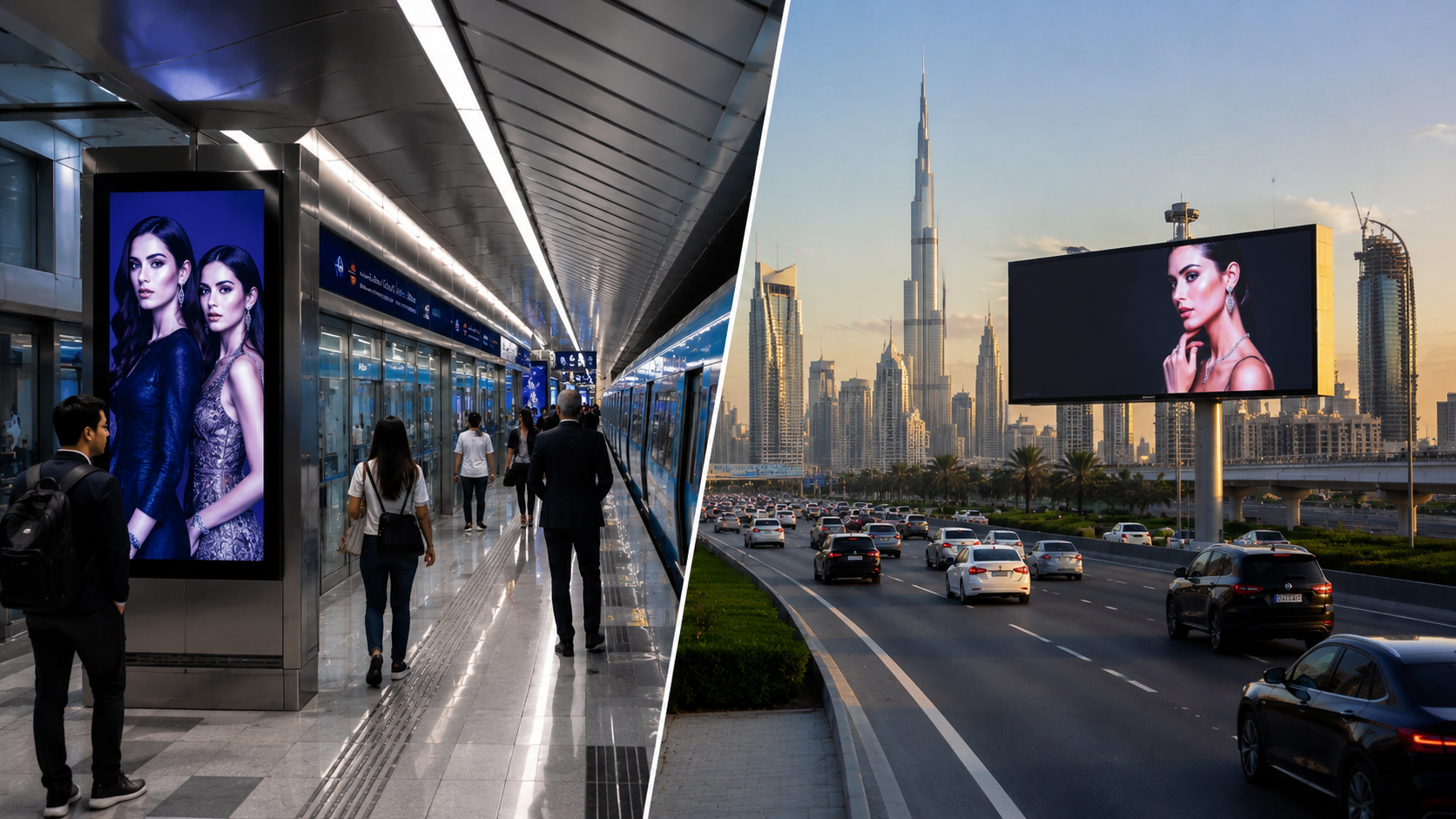
Picture two versions of the same morning in Dubai. In one, a commuter steps onto the Dubai Metro at Mall of the Emirates station, settles in for a twenty minute ride, and spends that time glancing around the carriage and the platform. In the other, a driver sits in traffic on Sheikh Zayed Road, eyes fixed ahead, watching the same stretch of skyline pass by every single day.
Both of these people are part of your potential audience. Both of them are, for a few minutes, not doing much else except looking around them. And both of them represent two of the most established advertising formats in Dubai, metro advertising and billboard advertising.
So which one should get your budget.
It is one of the most common questions brands ask when planning an out of home campaign in Dubai, and the honest answer is that it depends on what you are trying to achieve, who you are trying to reach, and how much you have to spend. At The Screen, we run campaigns across both formats every month, and this guide breaks down exactly how they compare, so you can make a decision with real information instead of guesswork.
The Quick Answer, Before the Details
If you want broad, citywide brand prestige and maximum visual impact, billboards, particularly on roads like Sheikh Zayed Road, are hard to beat. If you want repeated, focused exposure to a captive audience at a more accessible entry point, metro advertising often delivers stronger value per dirham.
Many of the most effective campaigns in Dubai do not choose one over the other. They use both, in different ways, for different goals. But to understand why, it helps to look at each format properly.
What Metro Advertising Actually Offers
Dubai Metro carries an enormous number of passengers every year, with commuters spending an average of twenty to thirty minutes per trip. During that time, they are largely a captive audience, sitting or standing, often looking at their surroundings rather than their phones, particularly during the in between moments of waiting on a platform or walking through a station.
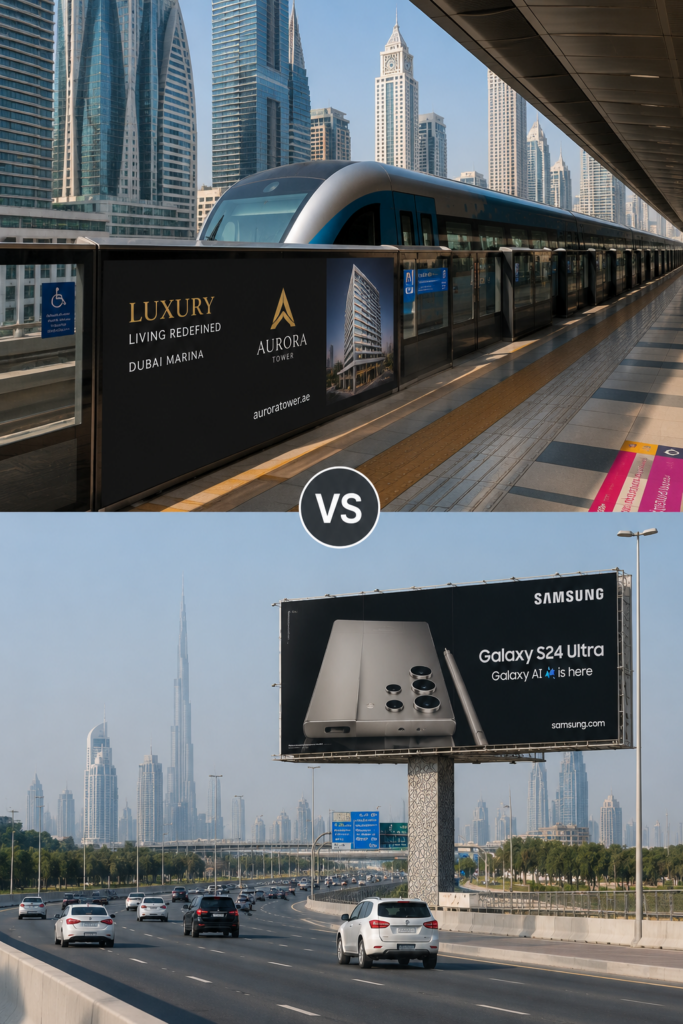
Metro advertising covers a wide range of formats, including digital screens on platforms and inside trains, static panels, full train wraps, platform screen door branding, escalator panels, and full station domination packages where a brand takes over an entire station’s advertising space.
One of the biggest advantages of metro advertising is geo targeting by station. A brand can choose to advertise specifically at stations near business districts, such as those serving DIFC, reaching a concentrated professional audience, or near major retail destinations like Dubai Mall and Mall of the Emirates stations, reaching shoppers and tourists. This level of targeting by location is something billboards generally cannot match in the same way.
What Billboard Advertising Actually Offers
Billboard advertising in Dubai is built around scale and visual dominance. A single large format billboard on a major road can be seen by hundreds of thousands of vehicles over the course of a month, creating an enormous volume of impressions.
Formats include unipoles, large digital LED screens, bridge banners over highways, and static panels, ranging from prestige locations like Sheikh Zayed Road to high traffic but more affordable roads like Al Khail Road or Mohammed Bin Zayed Road.
The biggest strength of billboard advertising is the sheer visual presence it gives a brand. There is a psychological weight to seeing your brand on a massive screen or panel along one of Dubai’s most recognisable roads, a sense of scale and credibility that smaller formats simply cannot replicate. For brands focused on prestige, citywide awareness, or simply being seen as a major player in the market, this matters.
Metro Advertising vs Billboard Advertising, Side by Side
| Factor | Metro Advertising | Billboard Advertising |
|---|---|---|
| Audience Type | Commuters, professionals, tourists, shoppers using public transport | Drivers and passengers on major roads |
| Dwell Time | Twenty to thirty minutes per trip, plus station time | A few seconds while passing, longer in heavy traffic |
| Targeting Precision | High, can target specific stations and lines | Lower, based on road and general traffic volume |
| Visual Impact | Strong within stations and trains, more intimate scale | Very high, large format, visible from a distance |
| Entry Level Cost | Generally more accessible | Generally higher, especially on premium roads |
| Best For | Repeated exposure, niche targeting, cost efficient frequency | Mass reach, brand prestige, citywide visibility |
Cost Breakdown, Metro Advertising vs Billboard Advertising
Here is a realistic look at how the two formats compare in terms of investment.
| Format | Typical Cost Range | Notes |
|---|---|---|
| Metro Station Digital Screen, Single Station | From AED 12,000 per month | Strong starting point for focused, station specific campaigns |
| Metro Station Static Panel, Single Station | From AED 5,000 per week | Accessible entry point for shorter campaigns |
| Full Metro Train Wrap | Significantly higher, priced on coverage and duration | Maximum visibility across the network |
| Standard Unipole, Secondary Roads | AED 35,000 to AED 80,000 per month | Strong entry point for billboard advertising |
| Al Khail Road or Business Bay Billboard | AED 60,000 to AED 200,000 per month | Central reach at a more moderate premium |
| Sheikh Zayed Road, Static Billboard | AED 200,000 to AED 600,000 per month | Prestige location, high traffic |
| Sheikh Zayed Road, Premium Digital LED | AED 225,000 to over AED 1,000,000 per month | Dubai’s most visible advertising corridor |
The takeaway on cost
Metro advertising generally offers a lower entry point, particularly for single station campaigns, making it more accessible for small and medium businesses or brands testing out of home advertising for the first time. Billboard advertising, particularly on premium roads, requires a significantly larger investment, but delivers a scale of visibility that metro advertising cannot fully replicate.
Which Audience Are You Actually Trying to Reach
This is the question that should drive the decision more than anything else.
If your customers are likely to be commuters, residents, or professionals working in business districts, metro advertising puts your brand directly into their daily routine, often multiple times a week, in an environment where they have time to actually notice and absorb your message.
If your customers are tourists, shoppers, or visitors moving between major destinations, metro stations near landmarks like Dubai Mall or Mall of the Emirates offer concentrated access to exactly that audience, often at a more accessible cost than advertising near the same landmarks via billboards.
If your goal is broad citywide awareness, regardless of how people move around the city, billboards on major roads offer a kind of unavoidable visibility that metro advertising, limited to those using public transport, cannot match.
If brand prestige and being seen as a major, established player matters to your positioning, particularly for industries like real estate, finance, or luxury retail, a presence on a road like Sheikh Zayed Road carries a signal value that is hard to replicate through other formats.
When Combining Both Makes Sense
For brands with the budget to consider it, combining metro and billboard advertising often produces stronger results than either format alone, for a simple reason. They reach people in different contexts, and repetition across different contexts is one of the most powerful drivers of brand recall.
A commuter who sees your brand on a metro platform in the morning, and then again on a billboard during a taxi ride later that day, is far more likely to remember that brand than someone who saw it in only one of those moments. Each format reinforces the other, without feeling repetitive, because the context is different each time.
This does not require an enormous budget split evenly between both. Many brands start with a stronger weighting toward the more accessible format, often metro advertising, while running a shorter, more focused billboard campaign around key periods, product launches, seasonal promotions, or major events, to add a layer of prestige and broad visibility on top of the ongoing metro presence.
Common Mistakes When Choosing Between the Two
Choosing based on prestige alone, without considering audience fit. A billboard on Sheikh Zayed Road is impressive, but if your customers are concentrated around specific metro accessible areas, that prestige may not translate into the right kind of exposure for your business.
Assuming metro advertising is only for budget conscious brands. While metro advertising does offer accessible entry points, full station domination and train wrap campaigns are major brand statements in their own right, used by some of the most recognisable names in the market.
Treating the comparison as either or, when a phased approach often works better. Testing metro advertising first, then adding billboard placements for a specific campaign window, can be a smarter way to build toward a larger combined strategy.
Not accounting for production differences. Metro formats and billboard formats often have different technical specifications and approval processes. Planning creative separately for each, rather than assuming one size fits all, avoids delays and wasted production costs.
Why The Screen Helps You Choose Without Bias
A lot of advertising agencies in Dubai specialise heavily in one format, and that specialisation can quietly influence the advice you get. A billboard focused agency will tend to recommend billboards. A transit focused agency will tend to recommend metro placements.
The Screen runs campaigns across both metro advertising and billboard advertising in Dubai, which means our recommendation is not shaped by which format we happen to sell more of. Instead, we start with your audience, your goals, and your budget, and build a plan around what genuinely fits, whether that is metro advertising, billboard advertising, or a combination of both.
Our team manages everything from location and station selection to creative specifications and RTA approvals across both formats, so whichever direction makes sense for your brand, the execution is handled by people who understand it properly.
When you work with The Screen, you are not choosing between two agencies with two different agendas. You are working with one team that knows both worlds well enough to tell you honestly which one, or which combination, will actually work for you.
Frequently Asked Questions
Is metro advertising cheaper than billboard advertising in Dubai?
Generally yes, particularly at the entry level. Metro station advertising can start from around AED 12,000 per month for a single station digital screen, or from around AED 5,000 per week for static panels, while billboard advertising, especially on premium roads like Sheikh Zayed Road, typically starts much higher and can exceed AED 200,000 per month for prime placements.
Which is more effective, metro ads or billboards, in Dubai?
Effectiveness depends on your audience and goal. Metro advertising offers longer dwell time and precise targeting by station, making it strong for repeated exposure to specific audiences. Billboard advertising offers massive scale and visual impact, making it strong for broad citywide awareness and brand prestige. Many brands find the best results by using both for different purposes.
Can I target a specific area of Dubai with metro advertising?
Yes. Metro advertising allows targeting by station, meaning you can focus on stations near business districts, shopping destinations, or residential areas depending on where your target audience is most likely to be.
How much does a billboard on Sheikh Zayed Road cost compared to metro advertising?
Sheikh Zayed Road billboards typically range from AED 200,000 to over AED 1,000,000 per month for premium digital placements, significantly higher than metro advertising, which can start from a few thousand dirhams per week for a single station placement.
Is metro advertising or billboard advertising better for a small business in Dubai?
For most small businesses, metro advertising tends to offer a more accessible entry point, particularly for businesses wanting to target specific areas where their customers are concentrated, such as near a particular station or business district.
Do metro ads and billboards require RTA approval in Dubai?
Yes, both formats require approval through the relevant authorities before campaigns go live, and an experienced media partner typically manages this process as part of the campaign setup.