Mall Advertising vs Metro Advertising Dubai: Which Delivers Better ROI for Your Brand in 2026?
Think about a shopper’s morning in Dubai. They leave home, take the metro toward Mall of the Emirates, spend twenty minutes on the journey glancing around the carriage, step off at the station, walk through a connected pathway, and arrive inside one of the busiest retail destinations in the world.
That single journey passes through two of Dubai’s most effective advertising environments, the metro and the mall, often within the same hour, sometimes within the same few hundred metres.
So when brands ask whether they should advertise in malls or on the metro, the honest answer is that these two audiences overlap more than most people realise, but the experience, cost, and strategic value of each format are genuinely different. At The Screen, we run campaigns across both environments regularly, and this guide breaks down exactly how they compare, so you can choose the one that fits your brand, or understand how they work even better together.
What Mall Advertising Actually Offers
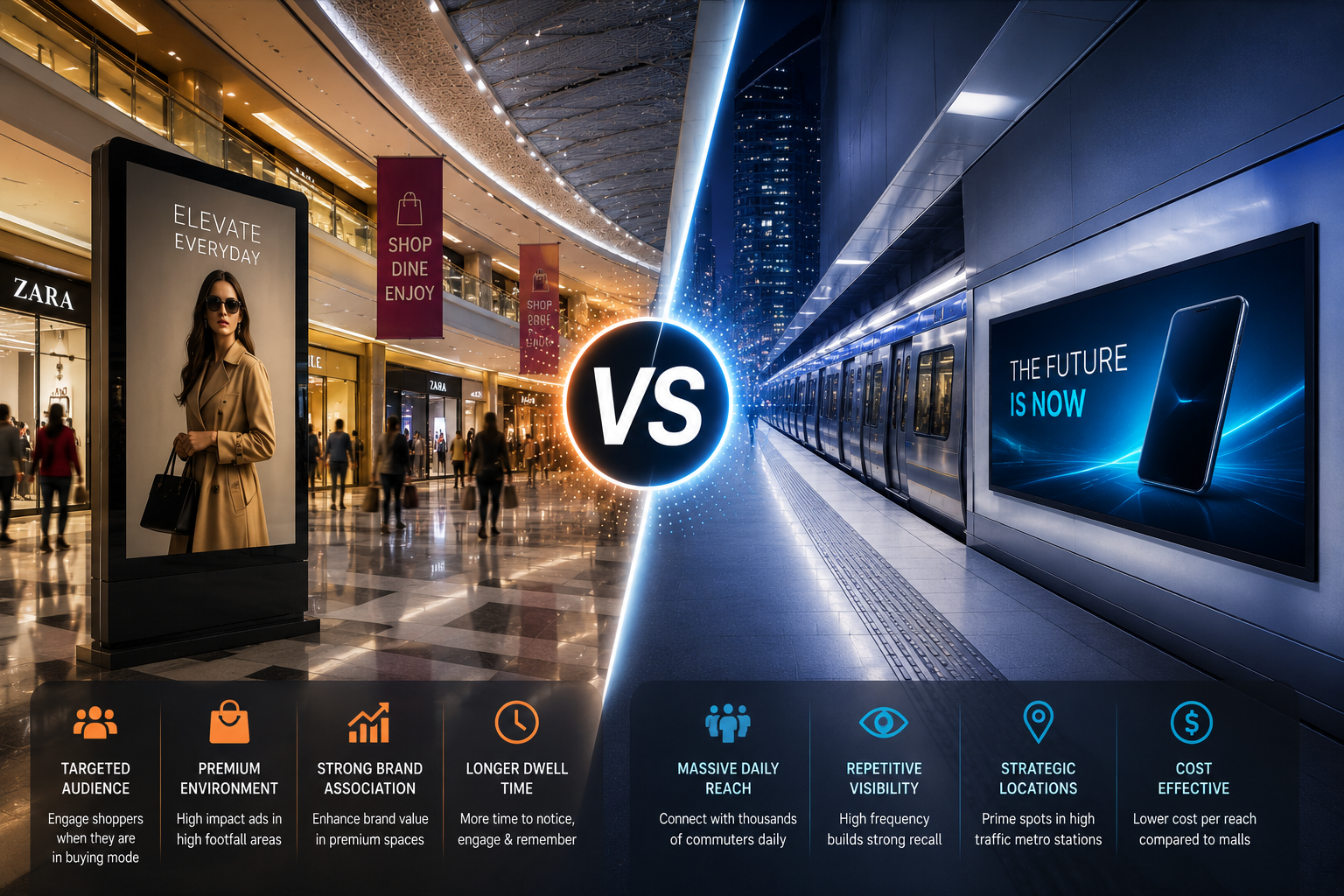
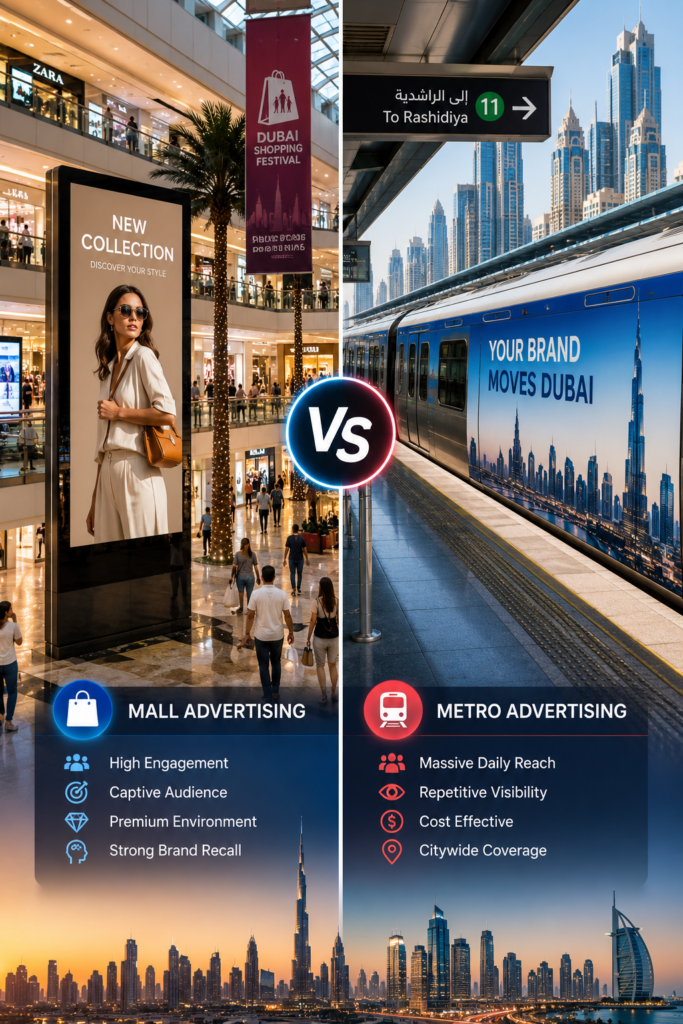
Dubai’s malls are not just shopping destinations, they are full day environments where people eat, socialise, and spend hours at a time, particularly during weekends and evenings. This creates exceptionally long dwell times, often stretching into hours, and an audience that is already in a spending mindset.
Mall advertising formats include large atrium digital screens, retail corridor screens positioned near specific stores, escalator and lift branding, directory screens, and kiosk activations. The key advantage is proximity to the point of purchase. A shopper seeing your ad on a corridor screen is often steps away from being able to act on it immediately, walking into a store, trying a product, or making a decision they were already considering.
Malls also carry a prestige element. Flagship locations like Dubai Mall and Mall of the Emirates are among the most visited destinations in the world, and a brand presence there can carry weight beyond the immediate campaign, signalling scale and credibility.
What Metro Advertising Actually Offers
Dubai Metro carries an enormous number of passengers, with commuters spending an average of twenty to thirty minutes per trip in a relatively calm, distraction free environment. Unlike a mall, where people are moving between many distractions, a metro journey often involves sitting or standing with limited stimulation, making advertising within stations and trains genuinely easy to notice.
Metro advertising formats include platform digital screens, static panels, train wraps, platform screen door branding, escalator panels, and full station domination packages. One of its biggest strengths is geo targeting by station. Advertising at stations near major malls, such as those serving Dubai Mall or Mall of the Emirates, reaches a similar audience to mall advertising itself, but at a different moment, before they have even entered the shopping environment.
Metro advertising also tends to offer a more accessible entry point than mall advertising, particularly for single station campaigns, making it a practical starting point for brands testing out of home advertising for the first time.
Mall Advertising vs Metro Advertising, Side by Side
| Factor | Mall Advertising | Metro Advertising |
|---|---|---|
| Audience Mindset | Active shopping mindset, relaxed, browsing | Commuting mindset, calm, often a captive audience |
| Dwell Time | Often one to several hours | Twenty to thirty minutes per trip, plus station time |
| Proximity to Purchase | Very close, often steps from point of sale | Earlier in the journey, before arrival at destination |
| Targeting Precision | By mall and by zone within the mall | By station and by line |
| Entry Level Cost | Generally higher, particularly flagship malls | Generally more accessible |
| Best For | Retail brands, impulse decisions, brand prestige | Repeated exposure, broad daily reach, cost efficient frequency |
Cost Breakdown, Mall Advertising vs Metro Advertising
Here is a realistic look at how the two formats compare in terms of investment in Dubai.
| Format | Typical Cost Range | Notes |
|---|---|---|
| Mall Digital Screen, Flagship Mall (Dubai Mall, Mall of the Emirates) | AED 90,000 to AED 200,000+ per month | Premium atrium or entrance positions |
| Mall Digital Screen, Mid Tier Mall | AED 20,000 to AED 90,000 per month | Strong reach, more accessible |
| Mall Static Panel or Escalator Branding | AED 5,000 to AED 40,000 per month | Per location, varies by mall |
| Metro Station Digital Screen, Single Station | From AED 12,000 per month | Strong starting point for focused campaigns |
| Metro Station Static Panel, Single Station | From AED 5,000 per week | Accessible entry point for shorter campaigns |
| Full Metro Train Wrap | Priced on coverage and duration | Maximum visibility across the network |
The takeaway on cost
Metro advertising generally offers a lower entry point, particularly for single station static campaigns, while mall advertising at flagship locations represents a larger investment but places your brand directly inside the moment of purchase. Mid tier malls and standard metro placements often sit in a similar, more moderate range, making them genuinely comparable options for many businesses.
The Audience Overlap Nobody Talks About
Here is something worth sitting with for a moment. A significant portion of mall visitors in Dubai, particularly at malls connected to or near metro stations, arrive using the metro. Mall of the Emirates, Dubai Mall, and several other major destinations have direct or nearby metro connections specifically because so many shoppers travel this way.
This means that, in many cases, mall advertising and metro advertising are not reaching two separate audiences. They are reaching the same audience at two different moments in their journey. A shopper might see your brand on a platform screen while waiting for their train, then see it again on a corridor screen inside the mall twenty minutes later.
This is not a coincidence brands should ignore. It is an opportunity. Two exposures to the same message, in two different contexts, within a short window of time, is one of the more effective patterns for building recall, without requiring the audience to be reached twice through entirely separate campaigns.
Which One Fits Your Business
If you are a retail brand with a physical store in a mall, mall advertising puts your message directly in front of people who are already there, already shopping, and potentially steps away from your store. The proximity to purchase is hard to replicate elsewhere.
If you are a food and beverage brand, both formats can work well, mall advertising near food courts and dining areas, and metro advertising at stations near your locations, particularly during commute times when people are thinking about their next meal.
If you are a brand without a presence inside malls, but want to reach mall going audiences, metro advertising at stations near major malls can be a smart way to reach a similar audience without the cost of mall placements themselves.
If your goal is broad daily awareness across a wide range of residents and commuters, metro advertising across multiple stations often provides strong, cost effective frequency.
If your goal is brand prestige tied to being present in iconic, high profile locations, flagship mall placements carry a signal value that metro advertising, while effective, does not fully replicate.
If you are working with a limited budget and want to test out of home advertising for the first time, metro advertising, particularly single station campaigns, often provides the most accessible way to begin.
When Combining Both Makes Sense
Given the audience overlap discussed earlier, combining mall and metro advertising is one of the more naturally synergistic strategies available in Dubai’s out of home landscape.
A practical approach many brands use is to run metro advertising at stations connected to or near their target malls, building awareness and recall during the commute, while running mall advertising inside those same malls to reinforce the message at the point of decision. The two formats effectively create a journey for the brand message that mirrors the journey the customer is already taking.
This does not require equal budgets across both. A brand might run a broader metro campaign across several stations at a more accessible cost, while running a more focused mall campaign at one or two flagship locations where their audience is most concentrated.
Common Mistakes When Choosing Between the Two
Assuming metro advertising cannot reach a premium audience
Stations near flagship malls and business districts serve some of the most valuable audiences in the city, often at a lower cost than advertising in the destination itself.
Assuming mall advertising is only worthwhile for retail brands with stores inside
Brands in finance, real estate, and other categories regularly use mall advertising for broad awareness among an audience with strong purchasing power, regardless of whether they have a physical presence there.
Choosing one format and ignoring the audience overlap
Brands that treat mall and metro advertising as entirely separate decisions sometimes miss the opportunity to reinforce the same message across a customer’s actual journey.
Not matching creative to the environment
A message designed for a calm, twenty minute metro journey may need a different pace and approach than one designed for a busy mall corridor where attention is split between many things.
Why The Screen Helps You Choose Without Bias
Many agencies in Dubai focus heavily on one environment, either malls or transit media, and that focus naturally shapes their recommendations. An agency built around mall inventory will lean toward malls. An agency built around transit media will lean toward metro placements.
The Screen runs campaigns across both mall advertising and metro advertising in Dubai, which means our recommendation is shaped by your goals and your audience, not by which inventory we have more of. We understand how these two environments connect, both physically and in terms of audience behaviour, and we use that understanding to build plans that make sense as a whole.
Our team handles everything from venue and station selection to creative guidance and approvals across both formats, so whichever direction fits your brand, or however you choose to combine them, the execution is in experienced hands.
When you work with The Screen, you are working with a team that sees the full journey your customer takes through Dubai, not just one stop along the way.
Frequently Asked Questions
Is mall advertising more expensive than metro advertising in Dubai?
Generally yes, particularly at flagship malls, where digital screen placements can range from AED 90,000 to over AED 200,000 per month. Metro advertising offers more accessible entry points, with single station digital screens starting from around AED 12,000 per month and static panels from around AED 5,000 per week.
Which is more effective, mall ads or metro ads, in Dubai?
Effectiveness depends on your goal. Mall advertising places your brand close to the point of purchase with long dwell times in a shopping mindset, while metro advertising offers broad, repeated exposure to a commuting audience at a more accessible cost. Many brands find the strongest results by using both together.
Which is more effective, mall ads or metro ads, in Dubai?
Yes, significantly. Major malls including Dubai Mall and Mall of the Emirates have direct or nearby metro connections, and a substantial portion of their visitors arrive via the metro, meaning the audiences for both formats often overlap.
Can a small business afford mall advertising in Dubai, or is metro advertising better?
For most small businesses, metro advertising tends to offer a more accessible starting point, particularly single station placements, while mall advertising, especially at flagship locations, generally requires a larger budget.
Should I choose mall advertising or metro advertising for a retail brand in Dubai?
If your retail brand has a physical store inside a mall, mall advertising offers strong proximity to the point of purchase. If you want to reach mall going audiences before they arrive, or do not have a presence inside the mall itself, metro advertising near that mall can be a smart complementary or alternative option.