Airport Advertising vs Metro Advertising Dubai: Which Delivers Better Results for Your Brand in 2026?
Both are transit environments. Both promise captive audiences with nowhere else to look. Both sit inside the out of home advertising category that is growing fastest across the UAE right now.
And yet, airport advertising and metro advertising in Dubai could hardly reach more different people.
One environment processes tens of millions of international travellers every year, people carrying luggage, holding boarding passes, often arriving from or departing to destinations across six continents. The other carries hundreds of millions of passenger journeys every year across Dubai’s two metro lines, daily commuters, residents, students, and workers moving through the city at the same time, every single day.
Understanding which of these two audiences your brand needs, and what it actually costs to reach each one, is the decision this guide is built to help you make. At The Screen, we plan and run campaigns in both environments regularly, and what follows is our most direct, honest comparison of the two.
The Fundamental Difference That Changes Everything
Before costs, formats, or strategies, the most important thing to understand about airport advertising versus metro advertising is what separates the two audiences at their core.
Airport advertising puts your brand in front of people who are in transition. They are arriving from somewhere or leaving for somewhere, often with heightened senses, time to absorb surroundings, and frequently in a mindset that is open to discovery, whether that is a new brand, a new product, or a new opportunity. A large proportion of DXB’s passengers are international visitors or high income residents travelling frequently, a demographic with above average spending power and decision making authority.
Metro advertising puts your brand in front of people who are in routine. The same residents, professionals, and workers making the same journey at the same time, day after day. This repetition is not a weakness. It is precisely what builds the kind of brand recall that compounds over time, turning a single exposure into familiarity, and familiarity into preference.
Neither audience is better in the abstract. They are different in ways that matter enormously depending on what your brand is trying to achieve.
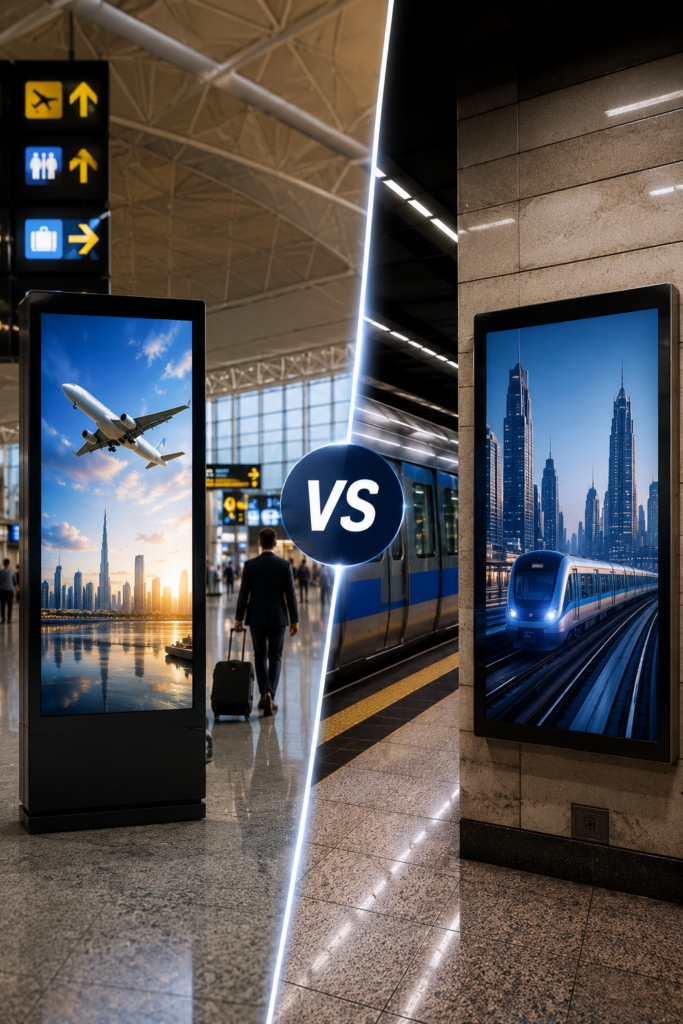
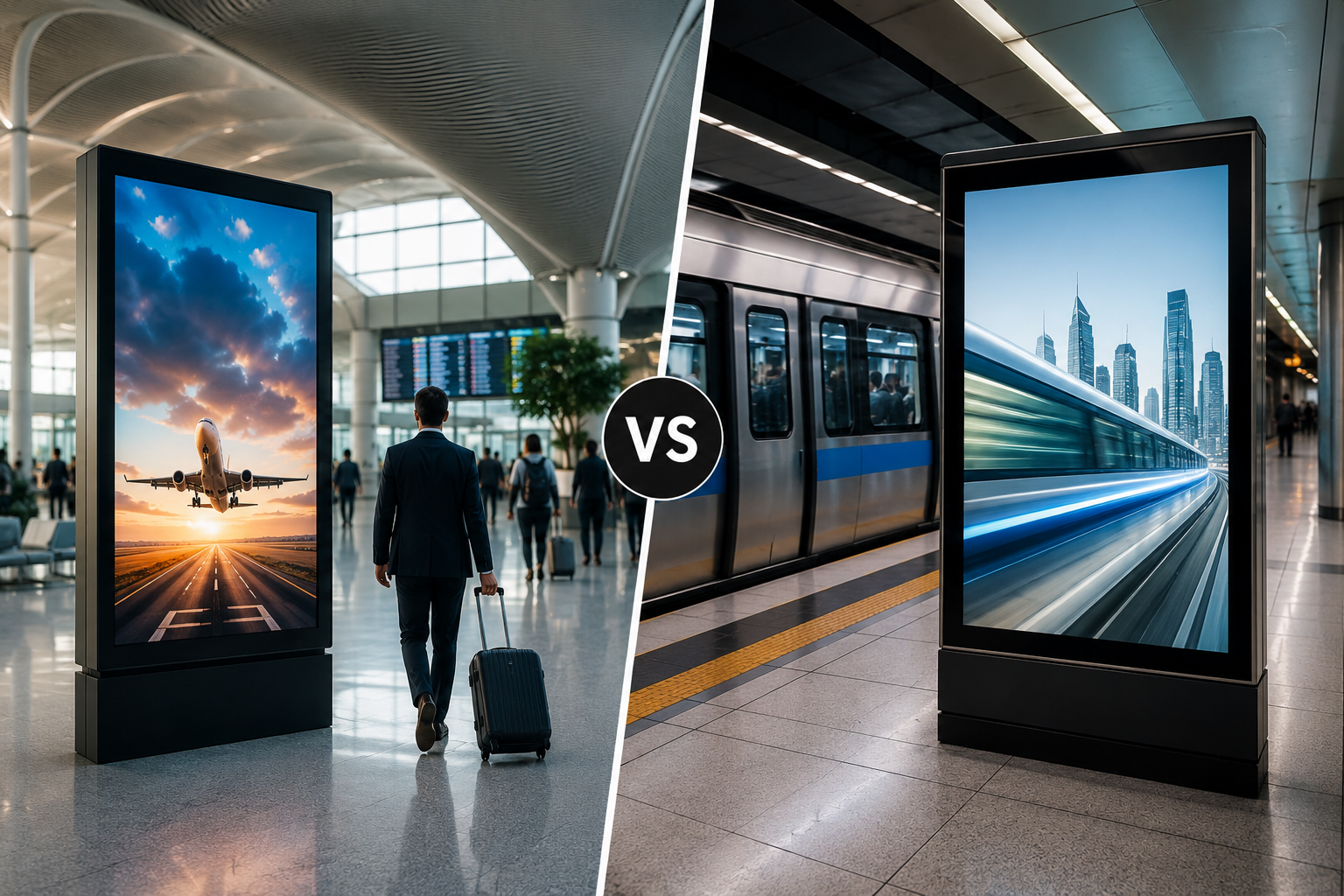
Airport Advertising vs Metro Advertising
Dubai International Airport, DXB, is one of the busiest international airports in the world, connecting passengers from across Europe, Asia, Africa, and the Americas through its terminals, with particularly strong volumes through Terminal 3, which handles Emirates flights and the most premium passenger mix.
The advertising environment inside DXB includes large format digital screens at arrivals and departures, static lightboxes and wall wraps in corridors and concourses, baggage claim advertising that captures passengers during long, attentive waits, aerobridge branding near boarding gates, lounge advertising in business and first class environments, and trolley and floor graphic branding throughout the terminals.
What makes airport advertising particularly valuable is the quality of the dwell time, not just its length. A passenger waiting at a gate or watching the baggage belt is calm, relatively unhurried, and often genuinely taking in their surroundings. The stimulation inside an airport is lower than inside a busy mall or metro station, which can translate into stronger recall for brands that show up well in that environment.
What Metro Advertising Offers in Dubai
Dubai Metro carries an enormous volume of daily journeys across its Red and Green lines, connecting major residential areas with business districts, shopping destinations, and tourist hotspots. Passengers spend an average of twenty to thirty minutes per trip inside the system, with additional time on platforms, in lifts, and on escalators.
Metro advertising formats include platform digital screens at individual stations, static panels in station concourses, in carriage screens and hanging cards, full train exterior and interior wraps, platform screen door branding, and full station domination packages for brands wanting to own an entire station’s advertising space.
The metro’s biggest strength is frequency. A resident commuting to work five days a week sees their route’s advertising environment ten times a week, forty times a month. Over a campaign period, that repetition builds a level of familiarity with a brand that a single high impact airport placement simply cannot replicate, simply because most airport passengers pass through once per trip rather than daily.
Airport Advertising vs Metro Advertising, Side by Side
| Factor | Airport Advertising | Metro Advertising |
|---|---|---|
| Primary Audience | International travellers, high income residents, business travellers | Daily commuters, residents, professionals, students |
| Audience Frequency | Usually one to a few times, high value single exposures | Daily or weekly, builds strong cumulative recall |
| Dwell Time | Twenty minutes to several hours per visit | Twenty to thirty minutes per journey plus station time |
| Audience Income Profile | Generally higher, premium passenger mix at DXB | Mixed, strongest in stations near business districts |
| Geo Targeting | By terminal zone and format within DXB | By station and by metro line |
| Entry Level Cost | Higher minimum investment | More accessible starting point |
| Best For | Luxury, real estate, finance, travel, international brand positioning | Retail, food and beverage, telecom, FMCG, broad Dubai audience |
Cost Breakdown, Airport Advertising vs Metro Advertising
Here is a realistic comparison of what each environment costs in Dubai in 2026.
| Format | Typical Cost Range (AED) | Notes |
|---|---|---|
| Airport Digital Screen, Premium Zone (Terminal 3) | 90,000 to 250,000+ per month | Highest footfall and premium passenger mix |
| Airport Static Lightbox or Wall Wrap | 30,000 to 80,000 per month | 24 hour visibility, no rotation |
| Baggage Claim Advertising | 35,000 to 90,000 per month | Long dwell time, captive at the belt |
| Lounge Advertising (Business or First Class Zones) | 50,000 to 150,000+ per month | Ultra premium audience, minimal clutter |
| Aerobridge or Gate Area Branding | 25,000 to 70,000 per month | Final impression before boarding |
| Metro Station Digital Screen, Single Station | From AED 12,000 per month | Strong entry point, flexible targeting by station |
| Metro Station Static Panel | From AED 5,000 per week | Accessible for shorter or more focused campaigns |
| Full Metro Train Wrap | Priced on coverage and duration | Maximum network wide visibility |
| Full Station Domination Package | Custom pricing | Single brand owns all advertising in one station |
The takeaway on cost
Metro advertising offers a lower entry point, with meaningful single station campaigns accessible from around AED 12,000 per month. Airport advertising generally requires a larger minimum investment for meaningful placements, typically from around AED 30,000 per month for smaller formats, and significantly more for premium Terminal 3 digital screens. However, for industries where a single high value customer can return a multiple of the campaign cost, airport advertising’s higher investment can deliver exceptional ROI.
Which Industries Belong in Which Environment
This question cuts to the heart of the decision for most brands, and the answer is often more obvious than it first appears.
Luxury retail, premium watches, and high end fashion. Airport advertising, particularly lounge and Terminal 3 placements, reaches the exact audience these brands need, frequent flyers with significant disposable income, often already in a discovery mindset heading into or returning from a trip.
Real estate developers targeting international investors. Airport advertising is the format of choice because international buyers, including the Gulf, European, and Asian investors that drive Dubai’s property market, pass through DXB specifically. A campaign inside the airport reaches this audience in one of the few moments when they are physically in Dubai or leaving it.
Private banking, wealth management, and financial services. The combination of dwell time and premium passenger profile inside airport lounge zones creates an advertising environment with almost no parallel for this audience.
Retail chains, supermarkets, and FMCG brands. Metro advertising, particularly at stations near major retail destinations and residential areas, tends to deliver stronger results because the audience is large, local, and making purchasing decisions daily.
Restaurants, cafes, and food and beverage brands. Metro advertising near busy commuter hours and stations adjacent to food and entertainment districts can be particularly effective at reaching people who are actively thinking about their next meal.
Telecom and technology brands targeting the broad UAE market. Metro advertising’s scale and daily frequency make it well suited to broad consumer awareness campaigns, where reaching a high volume of the general population repeatedly matters more than reaching a premium subset once.
Airlines and travel brands. An obvious natural fit for airport advertising, where the audience is already in a travel mindset and actively thinking about their next booking
When Splitting Budget Across Both Makes Sense
Some brands have both a premium positioning story and a broad awareness goal, and for them, splitting budget across both environments can deliver more than either alone.
Consider a hotel group. They want to reach international visitors arriving at DXB, an audience that might book directly for their stay. But they also want to build familiarity among Dubai residents who might recommend the property to family visiting from abroad, or book for a staycation. An airport campaign handles the first goal. A metro campaign, particularly at stations near the hotel or in key residential catchments, handles the second.
This kind of split does not require equal investment in both. A brand might invest eighty percent of their budget in the environment that fits their primary goal, with a smaller supporting campaign in the second environment to capture the audience that airport or metro advertising alone would miss.
Common Mistakes When Choosing Between the Two
Choosing airport advertising because it feels prestigious, without checking audience fit. If your product serves Dubai’s resident population primarily, and not international travellers, airport advertising, however impressive it looks on a media plan, may not be the most efficient use of budget.
Underestimating metro advertising’s ability to reach premium audiences. Stations near DIFC, Downtown Dubai, and business districts along the Red Line serve a professional, higher income audience that rivals the demographic profile of many airport zones.
Treating both as interchangeable because they are both transit environments. The audiences are genuinely different in frequency, origin, income profile, and mindset. Treating them as the same leads to underperforming campaigns and wasted spend.
Booking on price alone without understanding production requirements. Airport advertising has strict technical and content guidelines that vary by terminal zone and format type. Metro advertising has its own specifications. Creative built for one environment rarely transfers directly to the other.
Why The Screen Is the Right Partner for Both
Choosing between airport and metro advertising in Dubai, or figuring out how to combine them, is the kind of decision that benefits enormously from working with a team that has real experience in both environments, not just one.
The Screen runs campaigns across Dubai International Airport and across the Dubai Metro network, which means our recommendation is based on what actually fits your brand and your goals, rather than on which environment we happen to specialise in.
We handle everything from audience matching and placement selection to creative specifications, production guidance, authority approvals, and campaign scheduling across both environments. Whether you need a single focused campaign in one transit environment, or a combined strategy that touches your audience at both the airport and on their daily commute, our team builds the plan and executes it properly.
When you work with The Screen, you are working with a team that understands where your audience is in Dubai, not just where advertising space happens to be available.
Frequently Asked Questions
Is airport advertising more expensive than metro advertising in Dubai?
Generally yes. Airport advertising in Dubai typically starts from around AED 30,000 per month for smaller formats and can reach AED 250,000 or more per month for premium Terminal 3 digital screens. Metro advertising offers a more accessible starting point, with single station digital screens from around AED 12,000 per month and static panels available from around AED 5,000 per week.
Which reaches more people, airport advertising or metro advertising in Dubai?
Metro advertising reaches more people in terms of total daily journeys, given the scale of Dubai Metro’s daily ridership. Airport advertising reaches fewer people overall but tends to deliver a more premium, internationally diverse audience with higher average spending power.
Is airport advertising worth the extra cost compared to metro advertising?
For brands targeting international travellers, luxury consumers, high net worth individuals, or business decision makers, airport advertising often delivers exceptional value despite the higher cost, because the audience quality can justify a higher cost per contact. For brands targeting Dubai’s general resident population with broad awareness goals, metro advertising typically delivers stronger value per dirham.
Can the same creative work for both airport and metro advertising?
Generally not without adaptation. Airport formats, particularly large atrium screens and lounge placements, work in an environment with lower ambient stimulation and longer dwell time. Metro formats are seen in a busier environment with slightly shorter attention windows. Adapting the pace, format, and message for each environment significantly improves performance.
What is the minimum budget to start airport advertising in Dubai?
Smaller airport formats such as floor graphics or static wall panels can start from around AED 10,000 to AED 15,000 per month, though meaningful placements in high traffic zones typically require a starting budget of AED 30,000 to AED 50,000 per month before production costs.