Which Advertising Channel Delivers Better Visibility, Trust, and Real World Results?
Every brand in Dubai eventually faces the same budget conversation. You have a finite amount to spend on advertising, and you are deciding whether to put it into physical indoor screens, the ones you see in malls, metro stations, gyms, and office buildings, or into social media advertising on platforms like Instagram, Facebook, TikTok, and Snapchat.
Both channels promise to reach your audience. Both have agencies ready to tell you they are the right choice. And both have genuinely impressive statistics to back up that claim.
But here is what most agencies will not tell you. Neither channel is universally better. They work differently, reach people in fundamentally different states of mind, cost different amounts in the Dubai market, and are measurable in different ways. The right answer for your brand depends on what you are actually trying to achieve, and who you most need to reach.
At The Screen, our expertise is in indoor advertising. We are going to be transparent about that from the start, and precisely because we are transparent, we are going to give you an honest view of both sides, including the places where social media advertising has a real edge, and the places where indoor screens do something social media simply cannot.
The Core Difference Nobody Explains Clearly Enough
Before costs, before formats, before strategy, there is one fundamental difference between indoor screen advertising and social media advertising that shapes everything else.
Indoor screens reach people who did not choose to see your ad. They walked into a mall, sat down on a metro train, waited in a gym, or stood in a lift, and your brand is simply there, part of their environment. They cannot scroll past it. They cannot click away. In a busy food court or a quiet lounge, your message exists in their physical space for as long as they are there.
Social media advertising reaches people who are actively using a platform, and who have been trained by years of experience to scroll past anything that looks like an ad. The average person in the UAE sees hundreds of social media ads every single day. Attention, genuine attention, is increasingly the scarcest resource on any social platform.
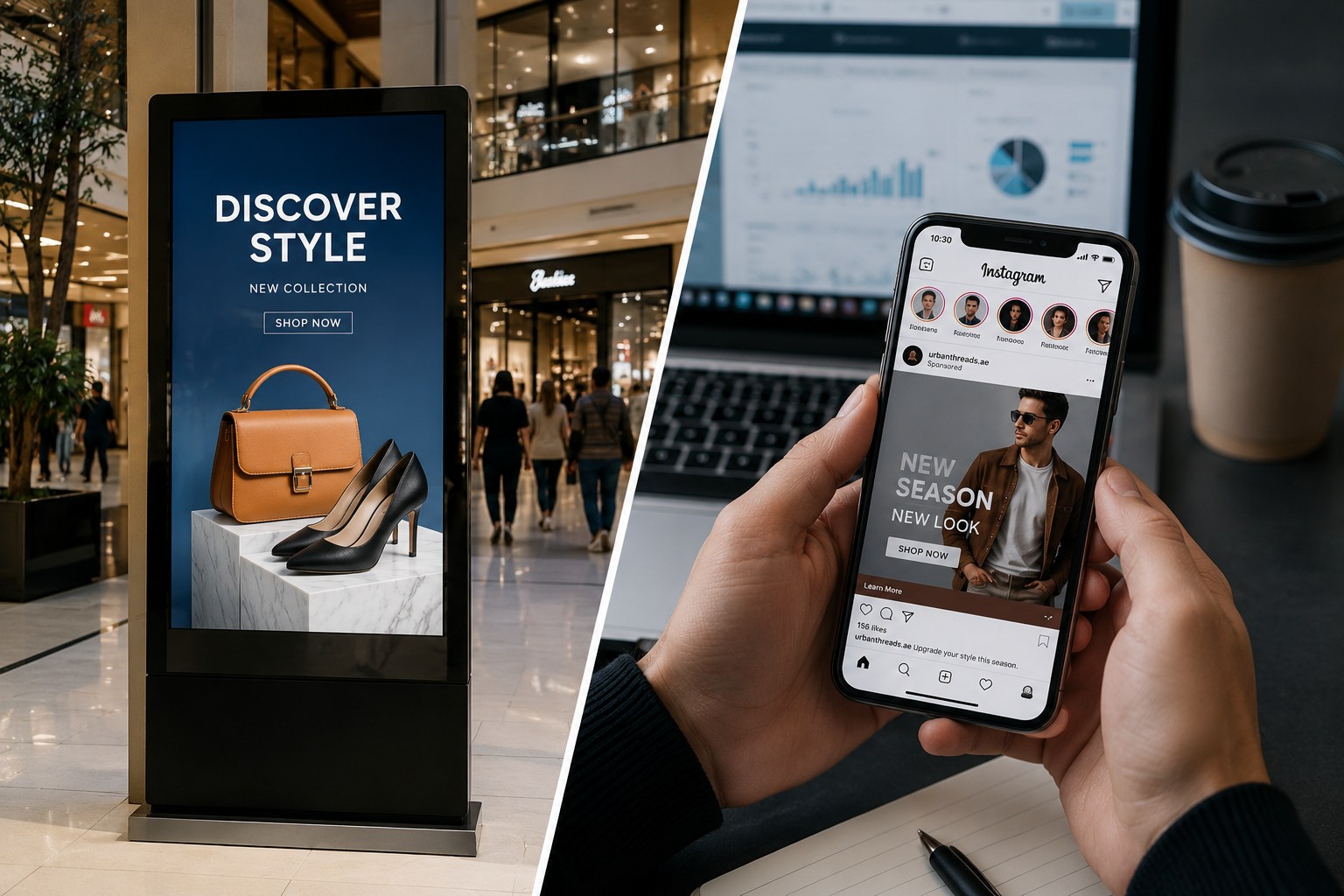
This is not an argument that indoor screens are better than social media, or vice versa. It is the foundational difference that should shape how you think about what each channel is actually buying for you. With indoor screens, you are buying presence in a physical space. With social media, you are buying a place in a competitive, distracted digital feed.
What Indoor Screen Advertising Offers in Dubai
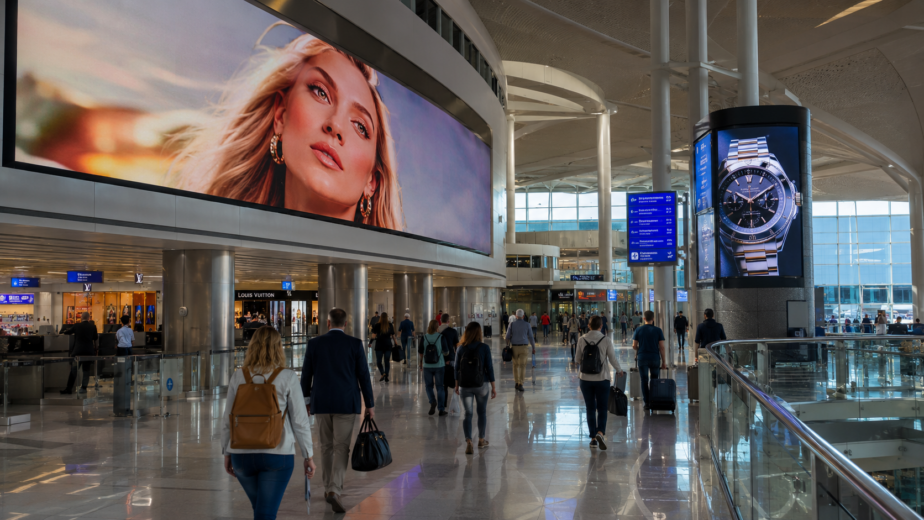
Dubai’s indoor advertising landscape covers an impressive range of environments, each with its own audience and dwell time characteristics. Mall screens in flagship destinations like Dubai Mall and Mall of the Emirates reach millions of visitors every month, many of them spending hours inside those environments. Metro station and in train screens reach daily commuters repeatedly across their routine. Gym screens, hospital screens, hotel lobby screens, and office tower placements each deliver specific, well defined audience groups in environments where attention levels are relatively high.
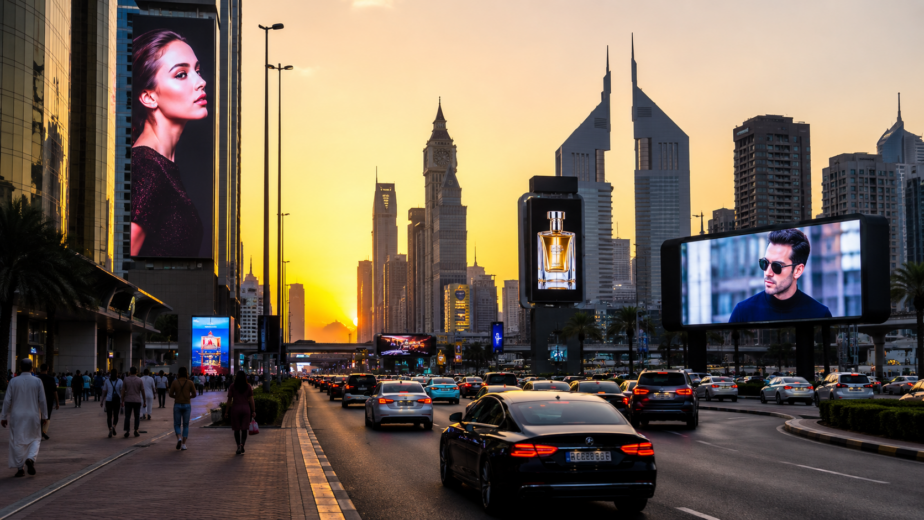
The key advantages of indoor screen advertising are the ones that social media cannot replicate. Physical presence creates a sense of scale and permanence. A brand on a large atrium screen at a flagship mall carries a weight of credibility that no Instagram story, however well targeted, quite matches. And the absence of direct competition within the frame means your ad is not sitting next to a competitor’s ad, or below a meme, or above a news story, it is simply there, in an environment your audience inhabits.
Dwell time is another genuine advantage. A commuter on the metro may be in the system for twenty to thirty minutes. A shopper in a mall may be there for two to three hours. During that time, the same brand message, seen once or several times across different screens in the same environment, has the opportunity to register in a way that a scrolled past social post rarely achieves.
What Social Media Advertising Offers in Dubai
Social media advertising in Dubai reaches an audience that is genuinely enormous and genuinely active. UAE social media penetration is among the highest in the world, and platforms like Instagram, Facebook, TikTok, and Snapchat are used daily by a large majority of the population, often for hours at a time.
The clearest advantages of social media advertising are precision targeting and measurability. Meta’s ad platform, for example, allows targeting by age, gender, location, income level, interests, behaviour, job title, and hundreds of other variables, letting brands reach a highly specific audience without paying to show their message to people who are unlikely to care. And the performance data available, clicks, impressions, conversions, cost per lead, ROAS, is delivered in near real time, making it straightforward to measure what is working and adjust quickly.
Social media advertising is also scalable in a way that indoor screen advertising is not. You can start a meaningful social campaign in Dubai for a few thousand dirhams a month and gradually increase spend as results prove out. Entry level indoor advertising, particularly in premium environments, typically requires a more significant minimum investment.
Indoor Screens vs Social Media Advertising, Side by Side
| Factor | Indoor Screen Advertising | Social Media Advertising |
|---|---|---|
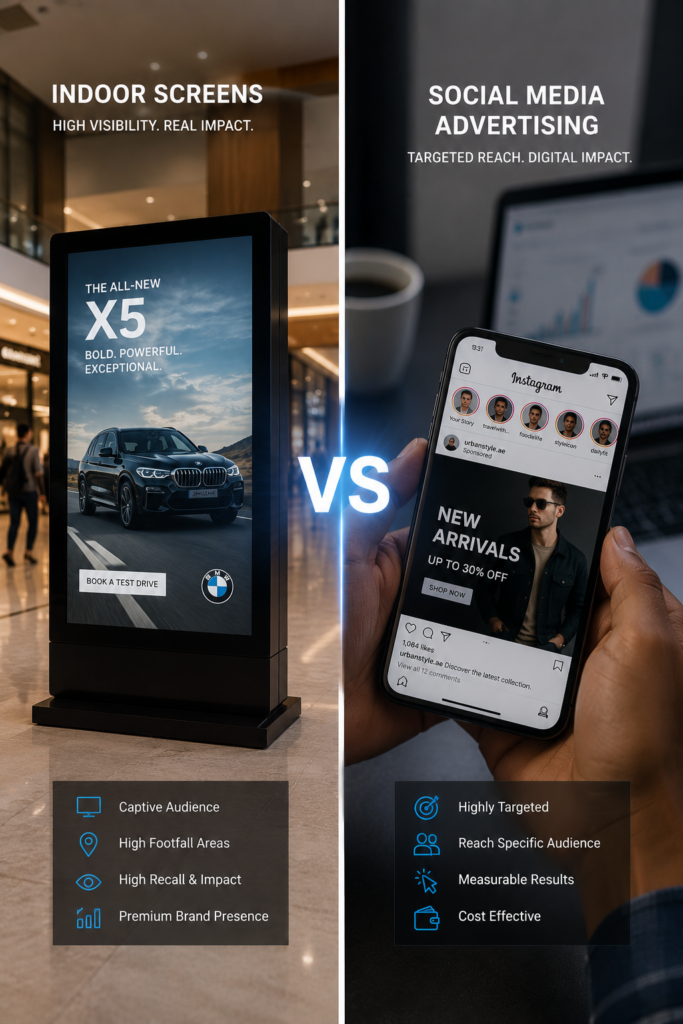
| Audience Attention | Captive, physical presence, cannot scroll past | Highly competitive, strong ad fatigue |
| Targeting Precision | By venue type and location | Extremely precise, demographic and behavioural |
| Ad Fatigue | Very low, physical environments feel fresh | High and increasing on all major platforms |
| Brand Prestige Signal | Strong, physical scale implies credibility | Lower, all brands compete for the same feed |
| Measurability | Impression and dwell data, harder to track conversions | Very detailed, real time conversion tracking |
| Entry Level Cost | Generally higher minimum investment | Very accessible, can start small |
| Best For | Brand presence, trust building, premium audiences | Performance campaigns, lead generation, direct response |
Cost Breakdown, Indoor Screens vs Social Media Advertising in Dubai
Here is a realistic comparison of what each channel costs in the Dubai market in 2026.
| Channel or Format | Typical Monthly Cost Range (AED) | Notes |
|---|---|---|
| Mall Digital Screen, Mid Tier Mall | 20,000 to 90,000 | Strong reach, retail environment |
| Mall Digital Screen, Flagship Mall | 90,000 to 200,000+ | Premium audience, maximum prestige |
| Metro Station Digital Screen | From 12,000 | Single station, commuter audience |
| Gym or Office Screen Placement | 5,000 to 35,000 | Niche, high frequency |
| Hospital or Clinic Screen | 8,000 to 30,000 | Long dwell time, specific audience |
| Facebook and Instagram Ads, Entry Level | 3,000 to 10,000 | Enough to gather early data |
| Facebook and Instagram Ads, Growth Level | 10,000 to 40,000 | Meaningful reach and conversions |
| TikTok Ads, Brand Awareness Campaign | 8,000 to 25,000 | Strong for younger demographics |
| Snapchat Ads UAE | 5,000 to 20,000 | Strong reach among UAE youth |
The key takeaway on cost
Social media advertising offers a genuinely lower entry point, and for brands just starting to test advertising in Dubai, a social campaign is often the most accessible first step. However, as budgets grow and brand objectives shift from direct response to brand building and trust, indoor screen advertising often delivers returns in areas, specifically prestige, recall, and physical presence, that social media spend simply cannot buy at any budget level.
The Ad Fatigue Problem Brands Cannot Ignore
There is a conversation happening inside most marketing teams right now that used to be whispered and is now spoken quite openly. Social media advertising in Dubai, as everywhere, is getting harder.
The number of brands competing for attention on Instagram, Facebook, TikTok, and Snapchat grows every year. The average consumer has developed sophisticated mental filters that block out anything that looks like an ad within a fraction of a second of seeing it. CPMs are rising. Click through rates are declining. The cost of acquiring a customer through social media has increased significantly over the past three years for most industries in the UAE.
This does not mean social media advertising has stopped working. It means the brands that rely on it exclusively are increasingly exposed to a single point of failure, because if the algorithm changes, or CPMs spike during a competitive period, or creative fatigue sets in, there is nothing else holding up their brand awareness.
Indoor screen advertising does not suffer from the same fatigue problem. A mall or metro audience has not developed the same kind of trained blindness toward physical screens that they have toward social feeds, partly because physical environments feel different from digital ones, and partly because the sheer variety of indoor advertising environments means there is always a degree of freshness compared to the predictable format of a social media feed.
The Case for Using Both Together
Here is the honest truth that most single channel agencies will never say out loud. The most effective advertising strategies in Dubai right now use indoor screens and social media advertising together, not as alternatives.
The reason is simple and backed by real behaviour. A consumer who sees a brand on a large mall screen on Saturday, and then sees a targeted social media ad from the same brand on Monday, responds to that second ad differently than they would if they had never encountered the brand physically. The physical impression creates familiarity. The social ad activates that familiarity into action.
This is often called cross channel lift, and research across multiple markets shows that consumers who have been exposed to out of home advertising, including indoor screens, show meaningfully higher engagement and conversion rates when they subsequently see the same brand’s digital advertising.
In practical terms for a Dubai brand, this means indoor screen advertising and social media advertising are often most valuable when the budget is split across both, with indoor screens handling brand building and awareness among the right audience, and social media handling retargeting, direct response, and lead generation among people already familiar with the brand.
When Indoor Screens Should Get More of Your Budget
When your goal is brand trust and credibility
Physical presence in premium environments builds trust in a way that digital impressions, however well targeted, cannot fully replicate. For real estate brands, financial services, luxury goods, and any category where trust is a prerequisite to purchase, indoor screen advertising earns its place in the budget.
When your target audience has developed strong social media ad blindness
High income professionals and experienced consumers in the UAE are among the most ad saturated audiences in the world. Reaching them through physical environments often cuts through more effectively than another sponsored post.
When you want to connect your brand to a specific place or lifestyle
Advertising inside Dubai Mall, a premium gym, or a five star hotel lobby does not just reach the audience in that space. It associates your brand with that space in the viewer’s memory, a form of brand positioning that social media cannot purchase.
When Social Media Should Get More of Your Budget
When your goal is direct response, leads, or e commerce sales. Social media’s targeting precision and conversion tracking make it the stronger tool for performance campaigns where each dirham needs to trace directly to a measurable outcome.
When your budget is limited and you need to test first. Social media advertising allows genuine testing at small budget levels in a way that indoor screen advertising cannot, making it the more practical starting point for brands earlier in their growth.
When you need to reach a very specific demographic segment. If your customer is, for example, a twenty five to thirty five year old female professional in Jumeirah with specific lifestyle interests, Meta’s targeting tools can reach her with a precision that even the best placed indoor screen cannot match.
Why The Screen Helps You Build the Right Mix
At The Screen, we are indoor advertising specialists. We are honest about that. What we are equally honest about is that the most effective brands in Dubai do not choose between indoor screens and social media, they use both deliberately, with each channel doing what it is actually best at.
Our role is to make the indoor advertising side of that equation work as hard as possible, placing your brand in the physical environments where your audience is most receptive, most attentive, and most likely to carry that impression into the digital interactions that follow.
We help brands understand which indoor venues fit their audience, what creative works in physical environments, how to align an indoor campaign with a concurrent social strategy, and how to measure the combined impact across both channels.
If you are currently putting all of your advertising budget into social media and wondering why the returns are plateauing, the missing piece might not be a better social strategy. It might be a physical presence that makes everything else work better.
Frequently Asked Questions
Is indoor screen advertising better than social media advertising in Dubai?
Neither is universally better. Indoor screen advertising excels at building brand trust, creating physical presence, and reaching captive audiences with high dwell time. Social media advertising excels at precise targeting, direct response, and measurable short term conversions. The strongest strategies in Dubai use both together.
How much does indoor screen advertising cost compared to social media ads in Dubai?
Neither is universally better. Indoor screen advertising excels at building brand trust, creating physical presence, and reaching captive audiences with high dwell time. Social media advertising excels at precise targeting, direct response, and measurable short term conversions. The strongest strategies in Dubai use both together.
Can indoor screen advertising and social media advertising work together?
Yes, and this combination tends to outperform either channel alone. Research consistently shows that consumers who have seen a brand in a physical environment engage more strongly with subsequent digital ads from the same brand, a pattern often called cross channel lift.
What is ad fatigue and does indoor screen advertising suffer from it?
Ad fatigue refers to the declining attention and response that consumers show toward advertising they see repeatedly, particularly on digital platforms where the volume of ads is extremely high. Indoor screen advertising tends to suffer less from this problem because physical environments feel different from social feeds and audiences have not developed the same trained blindness toward them..