The Choice Every Brand Faces Before Going Outdoors
You have decided to invest in outdoor advertising in Dubai. The location is shortlisted, the budget is set, and then your media partner asks a question that more brands struggle to answer than you might expect. Do you want a digital screen or a static billboard?
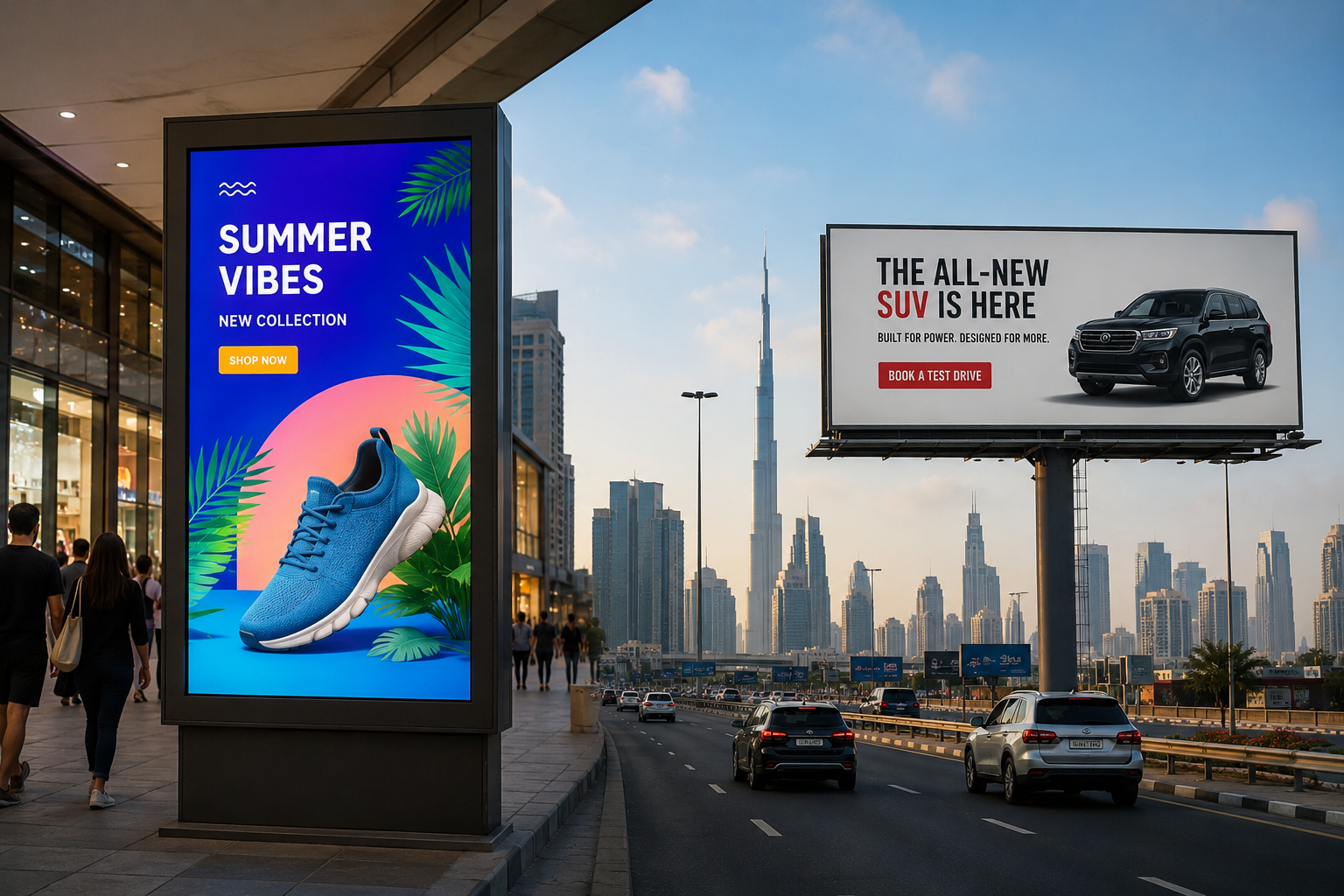
Both are sitting on the same road. Both reach the same passing traffic. Both carry your brand message to the same city. But they are not the same format, they do not cost the same, they do not produce the same results, and for many campaign types, choosing the wrong one can mean quietly wasting a significant portion of your budget.
At The Screen, we run campaigns across both digital screens and static billboards in Dubai. And because we work with both regularly, we can give you something most agencies cannot, an honest, unbiased breakdown of when each format actually wins, what it costs in the real Dubai market, and how to make the decision that is right for your specific campaign rather than the one that is easiest to sell.
What Actually Separates These Two Formats
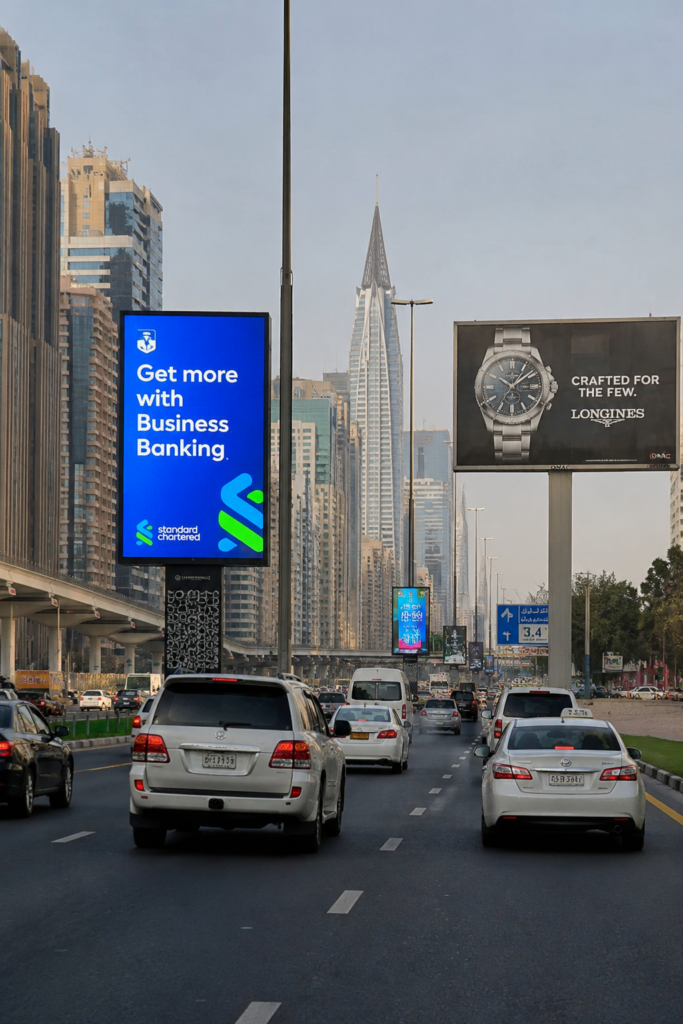
The most obvious difference between a digital screen and a static billboard is what you see. One glows, moves, and updates. The other holds a single printed image, cleanly, unmistakably, without change.
But the deeper difference is what that means for an advertiser.
A digital screen operates in a loop. Multiple advertisers typically share a single screen, each taking a slot within a rotation that cycles every sixty to one hundred and twenty seconds. Your ad appears, plays for ten to fifteen seconds, then gives way to the next brand in the loop. In return, you get a more accessible price point, since the cost of the screen is distributed across several advertisers, and you get flexibility, since your creative can be updated remotely without printing or installation.
A static billboard gives you the entire space for the entire duration of your booking. No rotation, no sharing, no competition for attention from the advertiser in the next slot. Your image sits there, in full view, for every vehicle that passes during every hour of your campaign. In return, you pay more for that exclusivity, and any creative change requires a new print and physical installation.
These are not just operational differences. They shape the fundamental economics of each format in ways that affect your campaign results directly.
What Digital Screens Do Better
Motion and animation capture attention in ways static formats cannot
Even a simple animation on a digital screen, a background that shifts, a headline that fades in, a logo that pulses, outperforms a comparable static image in attention tests. This is not a subtle difference. Research across multiple markets consistently shows that moving content generates higher recall than static content in the same environment.
Creative flexibility without new production costs
If you want to run a different message in the morning versus the evening, promote a weekend offer, or react to a live event happening in the city, a digital screen allows you to do all of that by uploading a new file. A static billboard requires a new print, new installation, and new production cost every single time.
Access to premium locations at a lower entry point
Buying a share of voice on a digital screen in a prime Sheikh Zayed Road location can sometimes provide access to a prestigious spot that would be financially out of reach as a fully exclusive static booking.
Dayparting
Digital screens allow content to change based on time of day, meaning a restaurant chain can show a breakfast promotion at 8am and a dinner offer at 6pm on the same screen, without additional media cost.
What Static Billboards Do Better
Full exclusivity, all the time
When you book a static billboard, that space belongs entirely to your brand for the duration. No other advertiser appears there, no rotation dilutes your presence, and every person who passes that location sees your message and only your message. This is a form of dominance that shared digital screens simply cannot offer at the same price point.
Simplicity of message
Some of the most effective outdoor advertising in history has been a single bold image and five words. Static formats reward this kind of stripped back, high impact creative in a way that digital screens, with their loop and their competition for attention, sometimes do not.
Perceived permanence builds trust
There is a psychological quality to a static billboard that brands in certain industries, particularly real estate developers, established financial institutions, and long term brand builders, have understood for decades. Something that sits unchanged in one location for weeks carries a sense of stability and permanence that an ad playing in a rotating loop does not fully replicate.
No content sharing means no creative context contamination.
When your brand plays in a loop between a fast food chain and a telecom offer, there is a risk that the overall context of the screen undercuts your positioning, particularly for premium brands. A static billboard gives you complete control over the visual context your brand inhabits.
Digital Screens vs Static Billboards, Side by Side
| Factor | Digital Screens | Static Billboards |
|---|---|---|
| Exclusivity | Shared rotation unless bought exclusively | Fully exclusive to one advertiser |
| Creative Flexibility | Update remotely, multiple creatives, dayparting | Fixed for the campaign duration |
| Visual Impact | High, motion and animation attract attention | Strong, especially with bold and minimal design |
| Production Cost Per Change | Very low, digital file upload only | Higher, new print and installation required |
| Entry Level Cost | Generally lower, shared screen cost | Generally higher for full exclusivity |
| Best For | Seasonal campaigns, multiple messages, premium access | Long term brand presence, single strong message |
| Brand Prestige Control | Shared with loop context | Full control over visual environment |
Cost Breakdown, Digital Screens vs Static Billboards in Dubai
Here is a realistic monthly investment comparison for both formats across Dubai’s main advertising corridors in 2026.
| Format and Location | Typical Monthly Cost Range (AED) | Notes |
|---|---|---|
| Digital Screen, Standard Share of Voice, Secondary Road | 6,000 to 30,000 | Shared rotation, accessible entry point |
| Digital Screen, Premium Location, Mid Share of Voice | 35,000 to 120,000 | Business Bay, Al Khail Road, Dubai Marina zone |
| Digital Screen, Sheikh Zayed Road, High Share of Voice | 120,000 to 400,000+ | Competitive premium corridor, strong visibility |
| Digital Screen, Full Exclusivity, Premium Location | 200,000 to 1,000,000+ | Equivalent to static in terms of single brand ownership |
| Static Billboard, Secondary or Community Road | 15,000 to 50,000 | Full exclusivity, simpler production |
| Static Billboard, Business Bay or Al Khail Road | 60,000 to 200,000 | Strong central reach, full exclusivity |
| Static Billboard, Sheikh Zayed Road | 200,000 to 600,000 | Premium static placement, fully exclusive |
The production cost factor that changes the economics
If your campaign involves multiple creative versions over its duration, the production cost difference between the two formats becomes significant. Changing creative on a digital screen costs little beyond the design itself. Changing creative on a static billboard requires new vinyl printing, physical removal of the old print, and new installation, which can add AED 5,000 to AED 20,000 or more per creative change depending on the size and location. For a twelve week campaign with three creative rotations, that difference alone can shift the overall economics considerably in favour of digital.
Industry by Industry, Which Format Tends to Win
Real estate developers.
Static billboards have long been the dominant format for property launches in Dubai, for good reason. The sense of permanence, the full exclusivity, and the scale of a large format static panel along a major road aligns naturally with the trust signals that property buyers need. However, digital screens are increasingly used for phase announcements and time sensitive offer windows alongside longer running static campaigns.
Retail brands and FMCG
Digital screens are generally the stronger choice here, primarily because retail and FMCG campaigns tend to change frequently, rotating seasonal offers, promotional pricing, and product launches. The creative flexibility of digital formats makes them far more cost efficient for high frequency messaging.
Luxury and premium brands
Both formats can work, but the choice depends on the specific execution. A luxury brand with a single, iconic campaign image may find the exclusivity and permanence of a static billboard more aligned with their positioning, while a luxury brand wanting to showcase multiple products or run a campaign with visual storytelling will find digital screens more expressive.
Food and beverage
Digital screens with dayparting capability are particularly powerful for food and beverage brands, allowing breakfast, lunch, and dinner messaging to target commuters and passersby at the exact moment when appetite and intent are highest.
Financial services and insurance
Static billboards tend to work well for establishing a stable, trustworthy brand presence, while digital screens suit promotional campaigns tied to specific products, interest rates, or seasonal offers.
The Creative Quality Factor Nobody Discusses Enough
Here is something that gets overlooked in almost every format comparison. The format choice matters less than the quality of the creative, and the right creative for a digital screen is genuinely different from the right creative for a static billboard.
A static billboard rewards simplicity. The best static outdoor advertising in Dubai tends to be bold imagery, minimal text, and a brand presence that communicates in under three seconds. Trying to put complex information or detailed offers onto a static billboard almost always underperforms.
A digital screen rewards motion and sequence. The best digital outdoor creative tells a micro story across its ten to fifteen second slot, using animation, transition, and dynamic elements to create something that genuinely cannot be ignored. A static image running on a digital screen, without any motion or animation, wastes most of what the format offers and often looks underwhelming compared to the other advertisers in the same rotation.
Before choosing between the two formats, ask your creative team or agency which type of content they can produce more effectively. A great static design beats a mediocre digital animation every time, regardless of which format is theoretically more capable.
When Combining Both Formats Makes the Most Sense
Many of Dubai’s most successful outdoor campaigns run digital and static formats simultaneously, not on the same road, but as complementary layers of a broader strategy.
A common approach is to use a digital screen at a high traffic location for broad, high frequency awareness, where the lower cost per impression and creative flexibility deliver reach efficiently, combined with a static billboard at a prestige location for sustained, exclusive brand presence that builds the kind of weight and permanence that digital rotation cannot fully achieve.
This combination is particularly effective for major product launches, brand repositioning campaigns, and any initiative where both broad reach and premium brand positioning matter, which, for most significant campaigns, is exactly the situation.
Why The Screen Helps You Choose the Right Format
Most outdoor advertising agencies in Dubai have inventory that leans toward one format or the other, and their recommendations, however professionally presented, tend to reflect what they have available rather than what genuinely fits your campaign.
The Screen works across both digital screens and static billboards in Dubai, which means our starting point is always your campaign goals, your audience, and your budget, not our inventory position. We have placed brands on the most prestigious static billboards along Sheikh Zayed Road and on digital networks across malls, metro corridors, and business districts, and we bring that cross format experience to every recommendation we make.
We also advise on creative strategy for each format, because we have seen enough campaigns across both to know that the format decision and the creative decision are inseparable. A campaign that chooses the right format but executes the wrong creative will always underperform a campaign that matches format and creative precisely.
When you work with The Screen, you get a partner who tells you honestly which format fits your goals, helps you understand what your creative needs to do in that format, and then executes the campaign with the attention it deserves.
Frequently Asked Questions
Is a digital screen better than a static billboard in Dubai?
Not universally. Digital screens offer creative flexibility, motion, and a lower entry point for shared placements. Static billboards offer full exclusivity, perceived permanence, and a clean brand environment. The better choice depends on your campaign type, budget, and how often your creative needs to change.
How much does a digital screen cost compared to a static billboard in Dubai?
Digital screen costs typically start from around AED 6,000 per month for a shared rotation on a secondary road, rising to AED 400,000 or more for high share of voice on premium corridors. Static billboards typically start from around AED 15,000 per month for secondary roads, with Sheikh Zayed Road placements ranging from AED 200,000 to AED 600,000 per month. Full exclusivity on a digital screen can cost as much as the equivalent static booking.
Do I share a digital screen with other advertisers in Dubai?
In most standard digital screen bookings, yes. Your ad plays as part of a rotation alongside other advertisers, each with their own slot within the loop. Full exclusivity on a digital screen is available but costs significantly more, often comparable to or exceeding the cost of a static billboard at the same location.
Is it cheaper to change creative on a digital screen than on a static billboard?
Yes, significantly. Changing creative on a digital screen typically costs only the design fee, since new files are uploaded remotely. Changing creative on a static billboard requires new print production and physical installation, which can add AED 5,000 to AED 20,000 or more per change depending on size and location.
Can I use the same creative for both a digital screen and a static billboard?
Not effectively. Digital screens benefit from motion, animation, and dynamic elements, while static billboards work best with bold, simple, instantly readable designs. Using static creative on a digital screen wastes the format’s primary advantage, and complex digital creative rarely translates well to a static panel.