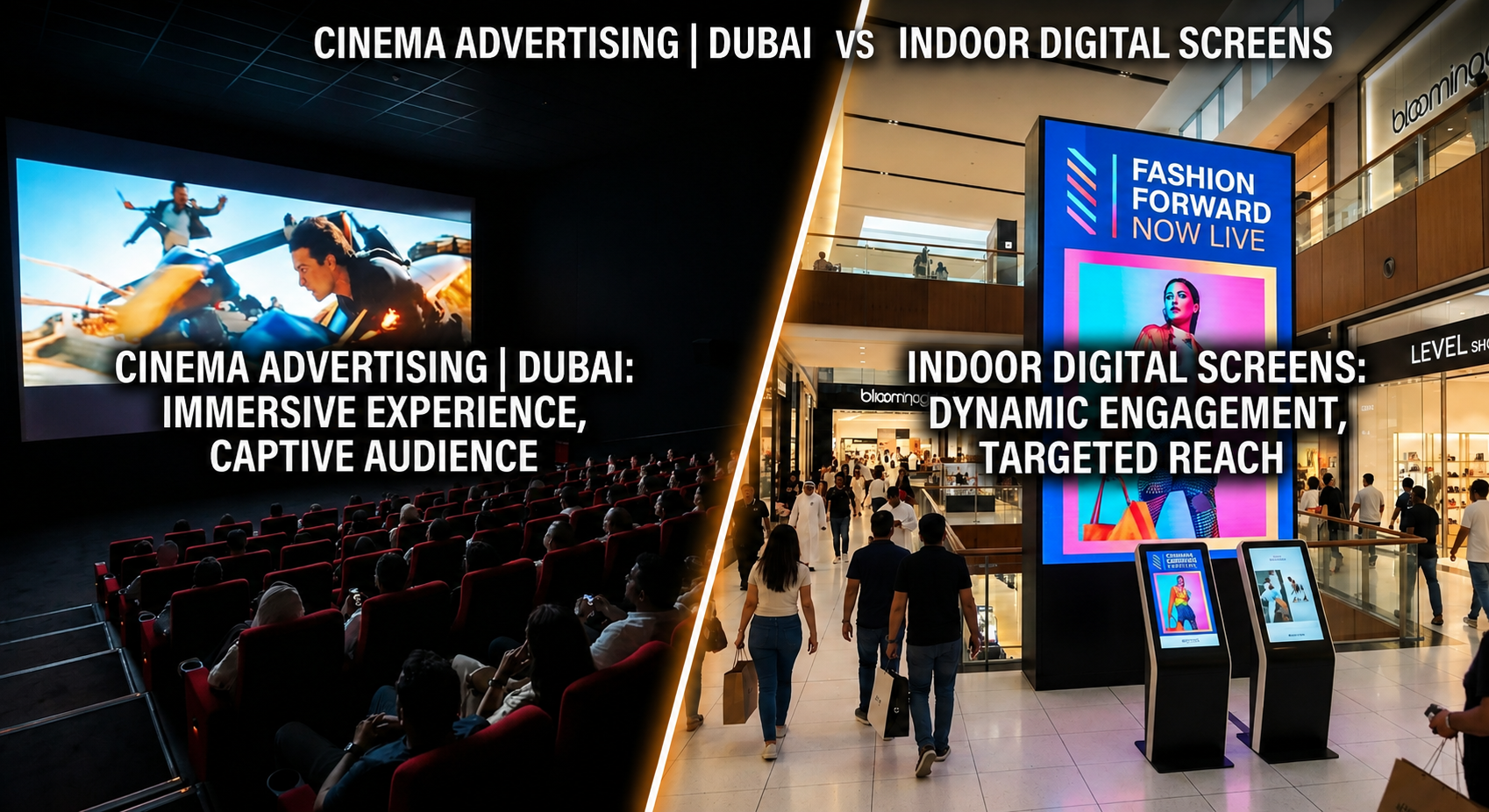
Cinema Advertising or Indoor Digital Screens: Which Is the Smarter Investment for Dubai Businesses?
Every marketing manager in Dubai eventually faces the same budget decision: where does the next advertising dirham actually work hardest? Two options keep coming up in media planning conversations, cinema advertising and indoor digital screen advertising, and they get compared far more often than they get properly understood.
Both channels put a brand in front of a captive audience. Both feel premium. But they behave very differently once you look past the pitch and into how often people actually see your ad, how much control you have over the campaign, and what it costs to sustain visibility over weeks rather than a single screening.
This guide breaks down cinema advertising versus indoor digital screens across reach, ROI, cost, and flexibility, so you can decide which one deserves your next campaign budget, or whether the smarter move is combining both.
What Is Cinema Advertising?
Cinema advertising places a brand’s video ad on the big screen before a film begins, typically as part of a pre-show slot alongside trailers and other advertisers. It’s a high-production, high-impact format, but exposure is limited to people attending that specific screening, at that specific time.
Cinema ads work well for brands with strong video assets and a message built for a captive, distraction-free few minutes. The tradeoff is frequency: a viewer sees the ad once, during that visit, and won’t see it again unless they return for another film.
What Is Indoor Digital Screen Advertising?
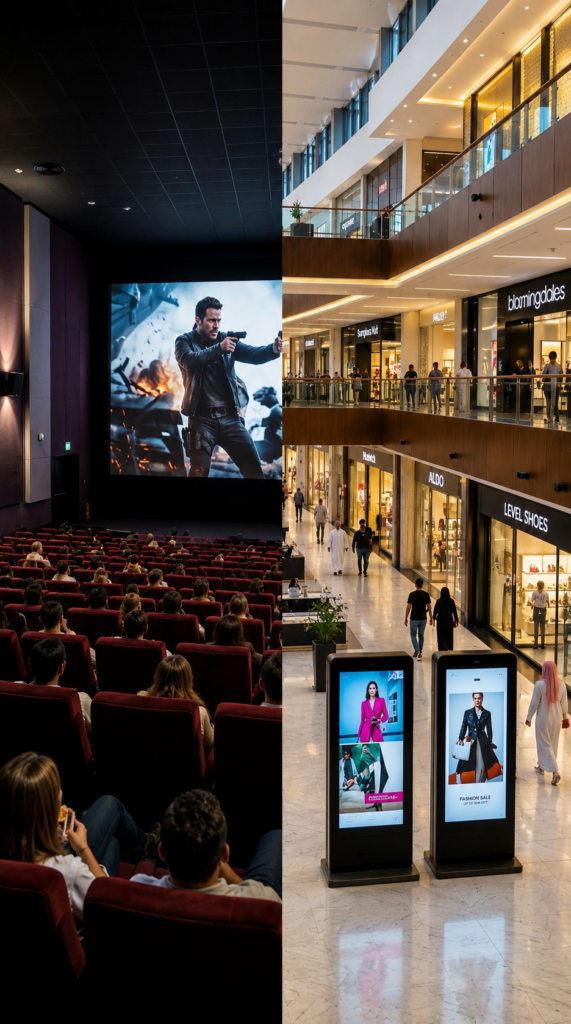
Indoor digital screen advertising, or DOOH, places ad content on digital screens inside malls, retail corridors, metro stations, and other high-footfall indoor environments. Unlike cinema, these screens run continuously throughout the day, showing rotating content to a constant stream of passing foot traffic.
This is the core structural difference between the two channels: cinema buys you a moment, indoor digital screens buy you sustained, repeated presence across a person’s everyday routine, whether they’re commuting, shopping, or walking through a retail hub.
Cinema Advertising vs Indoor Digital Screens (Comparison Table)
| Factor | Cinema Advertising | Indoor Digital Screens |
|---|---|---|
| Exposure frequency | Once per visit | Multiple times per day, ongoing |
| Audience size per touchpoint | Fixed by screening | Continuous foot traffic |
| Campaign flexibility | Low, locked to reel schedules | High, content can update quickly |
| Production cost | High (video required) | Low to moderate (static or video) |
| Targeting precision | By film genre and cinema location | By venue, footfall type, and neighbourhood |
| Measurability | Limited | Stronger, tied to footfall and placement data |
| Best for | Brand storytelling moments | Sustained visibility and recall |
Reach and Audience Comparison
Cinema advertising reaches a well-defined but narrow audience: people who bought a ticket for a specific film, at a specific time. That audience is engaged, but small relative to the daily footfall passing through a shopping mall or metro station.
Indoor digital screens reach a broader, more continuous stream of people. A single screen placement in a busy mall corridor or metro advertising in Dubai location can expose a brand to thousands of passersby daily, many of whom pass the same screen repeatedly over weeks, reinforcing recall in a way a single cinema screening cannot.
Practical example: A restaurant brand advertising in cinema reaches whoever attends that day’s screenings, once. The same brand on an indoor screen near a mall food court reaches shoppers walking past multiple times a week, at the exact moment they’re deciding where to eat.
ROI Comparison
ROI depends on what a brand is trying to achieve. Cinema advertising can deliver a strong emotional impact for a single, memorable brand moment, useful for major launches or seasonal campaigns with a big production budget behind them.
Indoor digital screens tend to deliver stronger ROI for ongoing visibility and conversion-focused goals, because frequency and continuous exposure build the kind of familiarity that drives walk-ins and enquiries, not just brand recall. The ROI advantage of DOOH comes largely from this repetition effect, something a single cinema screening structurally cannot replicate no matter how strong the creative is.
For most businesses outside of major entertainment or luxury launches, sustained visibility beats a single high-impact moment when the goal is measurable enquiries and footfall.
Cost Comparison
Cinema advertising typically requires a higher upfront investment, driven by video production costs and the premium pricing of prime screening slots. A short, professionally produced cinema ad can cost significantly more to create than the static or short-form content used on indoor screens.
Indoor digital screen advertising is generally more cost-efficient per exposure, because campaigns can run continuously across multiple locations without the repeated production costs cinema requires for fresh creative. For a detailed breakdown of pricing structures, see this digital signage advertising cost guide.
Mid-article note: If you’re weighing both channels against your actual budget, it’s worth requesting a media plan that compares real cost-per-exposure across cinema and indoor screen placements before committing spend to either.
Flexibility and Campaign Control
This is where indoor digital screens have a clear structural advantage. Cinema ad slots are locked into reel schedules and booked well in advance, making last-minute changes, seasonal offers, or reactive messaging difficult.
Indoor digital screens allow content to be updated quickly, letting brands adjust messaging for promotions, stock changes, or seasonal campaigns without renegotiating a media buy from scratch. For businesses that run frequent offers or need to react to market conditions, this flexibility alone often outweighs cinema’s production polish.
Which Industries Benefit More from Indoor Digital Screens?
- Retail and F&B brands needing frequent promotional updates and proximity to point-of-sale decisions
- Healthcare and wellness clinics relying on repeated trust-building exposure over cinema’s one-off impact
- Real estate companies promoting time-sensitive listings that need fast creative turnaround
- Automotive brands running seasonal offers across multiple showroom-adjacent locations
- Beauty and FMCG brands benefiting from proximity advertising near retail and mall purchase points
Luxury and entertainment brands launching a major campaign moment may still find cinema advertising valuable, particularly when paired with indoor screens for sustained follow-through.
Common Mistakes Businesses Make When Choosing an Advertising Channel
- Choosing cinema purely for perceived prestige, without a plan for sustained visibility beyond a single screening window
- Underestimating production costs required for a cinema-ready video asset
- Treating both channels as interchangeable, when they serve different stages of brand awareness and recall
- Ignoring footfall data when selecting indoor screen locations, resulting in low-relevance placements
- Running a single-channel campaign instead of combining a high-impact moment with sustained indoor screen frequency
Mini Dubai Campaign Case Study (Anonymous)
A mid-sized retail brand in Dubai initially allocated its entire quarterly advertising budget to a cinema campaign timed around a major film release, expecting a strong brand lift. While the campaign generated a short-term spike in social mentions, in-store enquiries returned to baseline within days of the screening window ending.
For the following quarter, the brand shifted the majority of that budget into indoor digital screens across two mall locations, running continuously for eight weeks. Store enquiries showed a steadier, sustained increase over the full campaign period, and the brand’s marketing team noted stronger correlation between screen placement proximity and walk-in traffic than the earlier cinema push had delivered. This reflects a broader pattern seen across Dubai’s advertising market, one explored further in how brands are shifting spend toward DOOH.
Advertising Channel Decision Checklist
- ✔ Define whether your goal is a single high-impact moment or sustained recall
- ✔ Confirm your budget covers both media cost and creative production
- ✔ Check how frequently you’ll need to update messaging or offers
- ✔ Assess whether your audience aligns with cinema-going habits or everyday footfall locations
- ✔ Compare cost-per-exposure, not just headline campaign cost
- ✔ Consider combining both channels for launch impact plus sustained visibility
Frequently Asked Questions
Is cinema advertising more effective than indoor digital screens in Dubai?
It depends on the goal. Cinema suits high-impact brand moments, while indoor digital screens suit sustained visibility and recall.
Which is more affordable, cinema advertising or indoor digital screens?
Indoor digital screens are generally more cost-efficient per exposure, since cinema requires higher production and slot costs.
Can small businesses use cinema advertising in Dubai?
Technically yes, but the production and slot costs often make indoor digital screens a more practical starting point for smaller budgets.
How often do people see an indoor digital screen ad compared to a cinema ad?
Indoor screens typically deliver repeated exposure to the same audience over days or weeks, while a cinema ad is seen once per screening.
. Which industries benefit most from indoor digital screen advertising?
Retail, F&B, healthcare, real estate, and automotive brands tend to see the strongest results due to proximity to purchase decisions.
Ready to Compare Your Options?
Choosing between cinema advertising and indoor digital screens shouldn’t come down to guesswork or prestige. It should come down to which channel actually delivers the exposure, frequency, and ROI your business needs.
Book a consultation with TheScreen to get a media plan comparing indoor digital screen locations, advertising rates, and expected reach for your specific campaign goals.