Which Advertising Channel Delivers Better Visibility in Dubai?
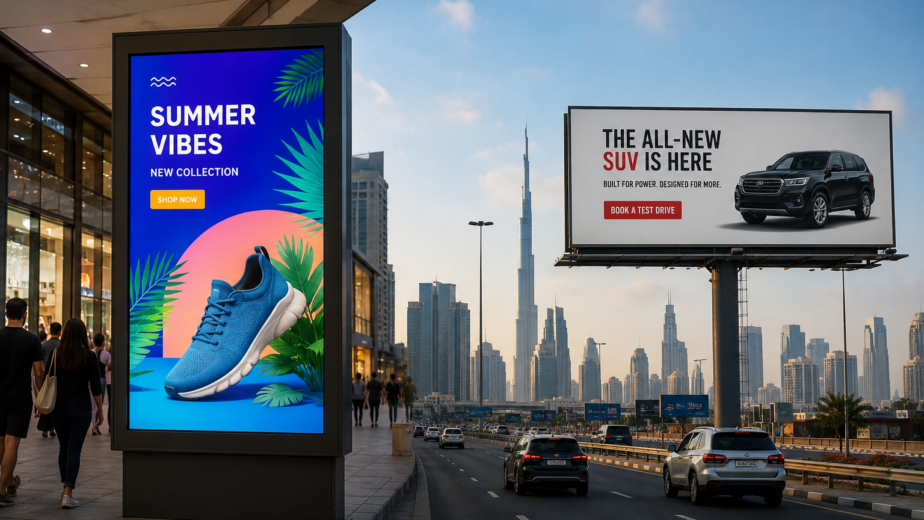
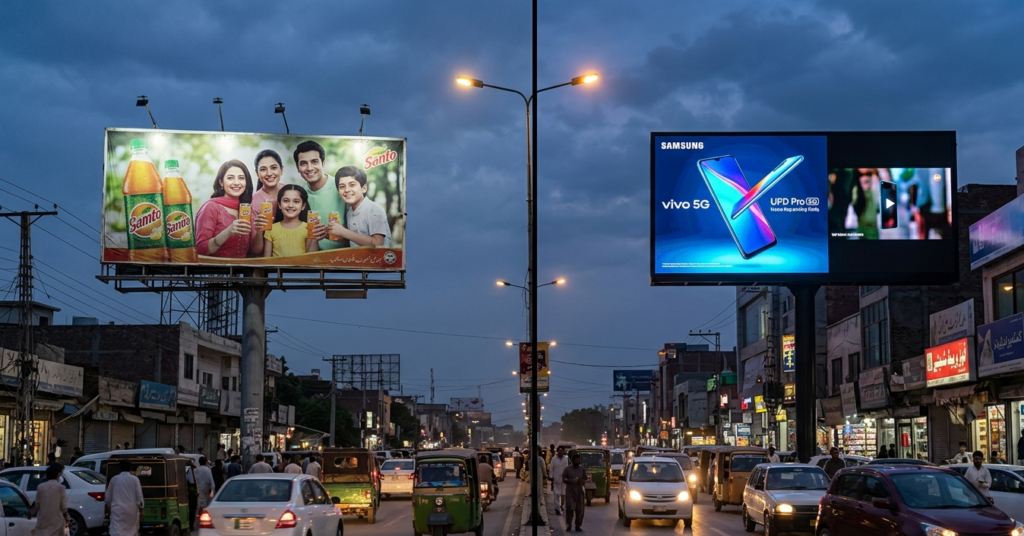
Drive down almost any major road in Dubai today and you will notice something that has changed quietly over the past few years. Where there used to be a single printed panel holding the same image for weeks, there is now often a glowing LED screen, cycling through several brands, sometimes changing every few seconds.
This shift has a name. It is the rise of DOOH, short for Digital Out of Home advertising, and it has become one of the fastest growing categories in outdoor media across the UAE. But traditional outdoor advertising, the static billboards, printed panels, and vinyl wraps that have been part of Dubai’s skyline for decades, has not disappeared. In many cases, it still holds its own.
So when a brand comes to us asking which one they should choose, DOOH or traditional outdoor advertising, the honest answer is that both are very much alive in Dubai, and the right choice depends on what you are trying to do. At The Screen, we plan and run campaigns across both formats, and this guide lays out exactly how they compare, what they cost, and how to think about choosing between them.
What DOOH Actually Means, in Plain Terms
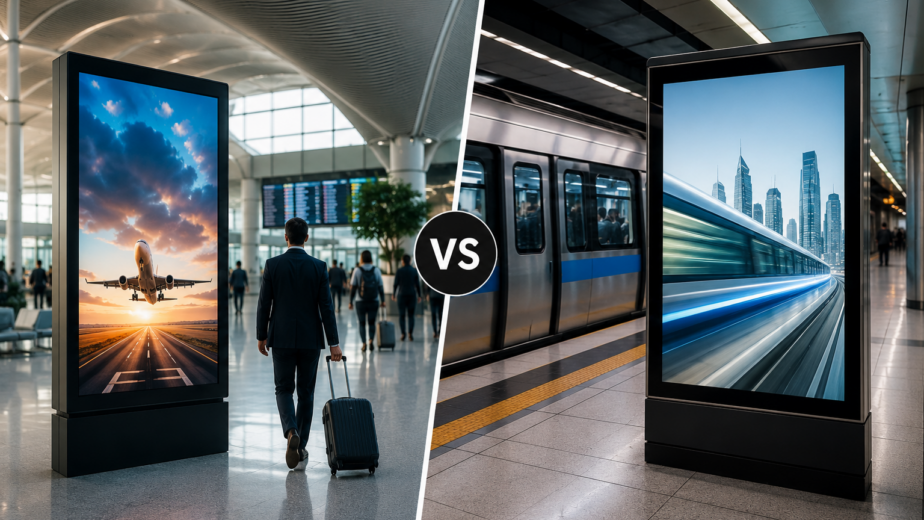
DOOH stands for Digital Out of Home advertising. In simple terms, it refers to any outdoor advertising format that uses a digital screen rather than a printed surface. This includes large LED billboards on highways, digital panels in malls, screens at metro stations, and digital displays at airports and other public venues.
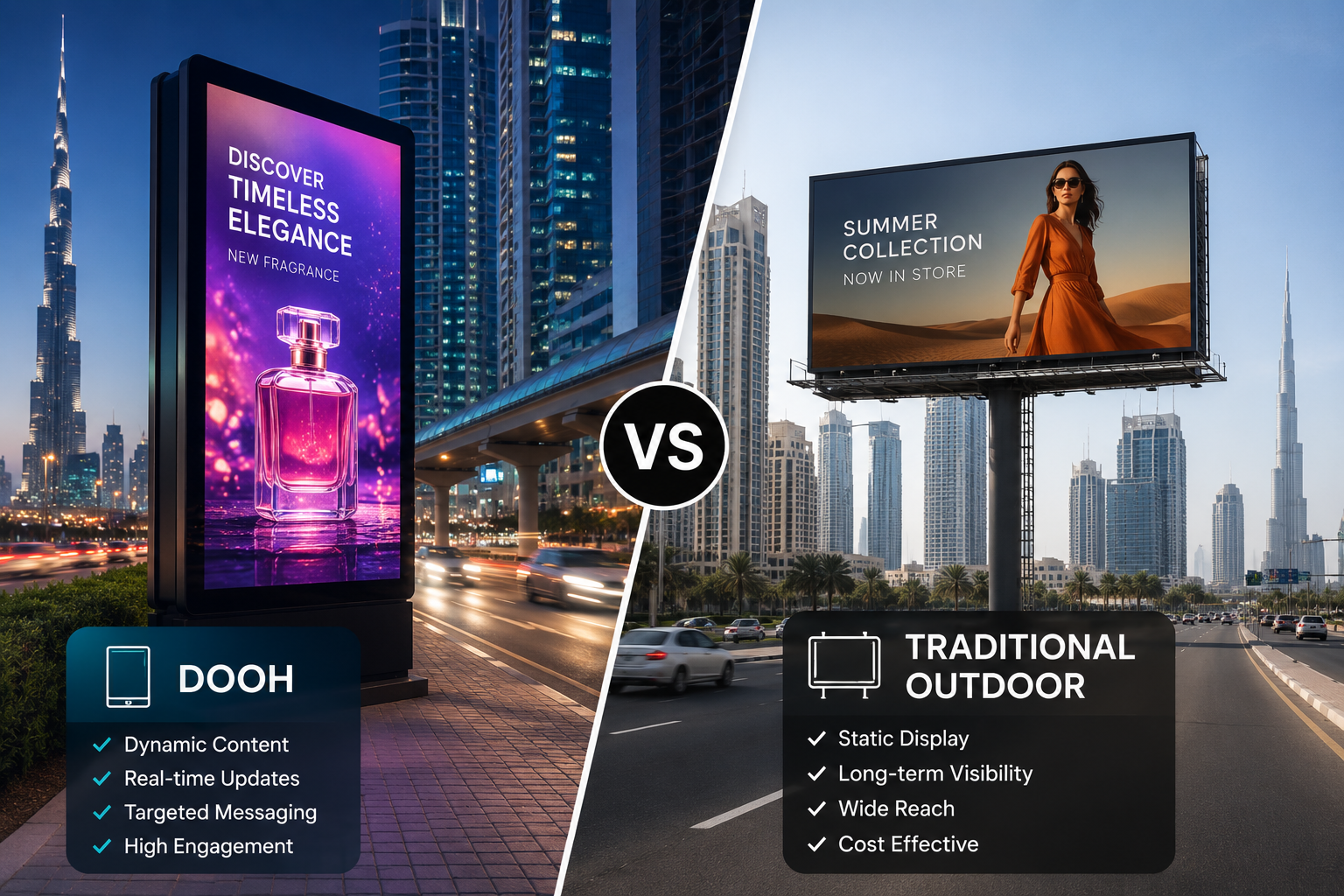
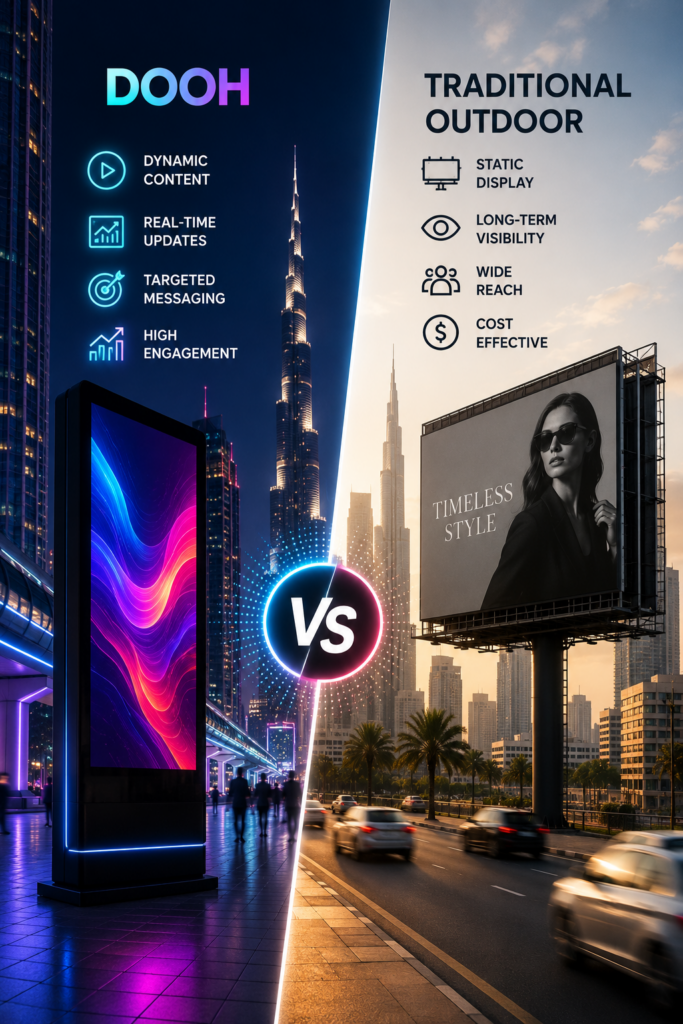
The key difference between DOOH and traditional outdoor advertising is not just the screen itself, but how it is used. A traditional billboard holds one image, for one advertiser, for the length of the booking, often two to four weeks at a time. A DOOH screen can show multiple pieces of content in rotation, update remotely without anyone visiting the site, and even change based on factors like time of day or weather.
This flexibility is the foundation of everything else that makes DOOH different, from how it is priced to how it is used strategically.
What Traditional Outdoor Advertising Still Offers
Traditional outdoor advertising covers static billboards, unipoles, printed panels, and vinyl wraps, the formats that have defined Dubai’s roadside advertising for decades.
The biggest strength of traditional outdoor advertising is exclusivity and permanence. When you book a static billboard, your message owns that space for the entire duration, with no rotation and no sharing with other advertisers. For brands that want a single, strong message to sit in front of an audience repeatedly over weeks, without any competition for attention on that specific spot, this remains a powerful option.
Traditional formats also tend to have simpler production requirements. A well designed printed panel does not need video content, animation, or technical specifications for digital screens, which can make the creative process more straightforward for some brands.
DOOH vs Traditional Outdoor Advertising, Side by Side
| Factor | DOOH (Digital) | Traditional Outdoor (Static) |
|---|---|---|
| Content Flexibility | Can update remotely, run multiple creatives, rotate by time of day | Fixed for the full booking period |
| Exclusivity | Often shared between several advertisers in rotation, unless bought exclusively | Fully exclusive to one advertiser |
| Visual Impact | High, motion and animation draw attention | Strong, especially with bold, simple design |
| Production Cost | Lower per campaign, since there is no printing or physical installation for content changes | Higher per change, since new creative means new printing and installation |
| Pricing Model | Often sold by CPM or share of voice within a loop | Often sold as a flat monthly rate for the full space |
| Best For | Time sensitive promotions, multiple messages, seasonal campaigns | Long term brand presence, single strong message, maximum exclusivity |
Cost Breakdown, DOOH vs Traditional Outdoor Advertising in Dubai
Here is a realistic look at how pricing compares between the two formats across different placement types.
| Format | Typical Monthly Cost Range (AED) | Notes |
|---|---|---|
| Static Billboard, Secondary Roads | 35,000 to 80,000 | Standard unipoles, full exclusivity |
| Static Billboard, Sheikh Zayed Road | 200,000 to 600,000 | Premium static placement, fully exclusive |
| Digital LED Billboard, Standard Locations | From AED 6,000 to AED 50,000, depending on share of voice | Shared rotation, priced by slot share |
| Digital LED Billboard, Sheikh Zayed Road | 225,000 to over 1,000,000 | Premium digital, can be bought with higher share of voice for impact |
| DOOH CPM Rate, Standard Loop | Approximately AED 32 to AED 45 per thousand impressions for a ten second slot | Common pricing model for shared digital screens |
A note on production costs
This is where the comparison often shifts in DOOH’s favour for brands planning multiple creative versions. A static billboard campaign that wants three different messages over a quarter needs three separate rounds of printing and installation. A DOOH campaign with the same goal simply uploads three digital files, with no additional physical production cost. For brands running a single message for a long period, this advantage matters less, since the static format only needs one round of production regardless.
When DOOH Is the Stronger Choice
When your message needs to change
Seasonal promotions, limited time offers, event countdowns, or any campaign with multiple phases benefits enormously from the ability to update content without new production each time.
When you want to run multiple creative versions
Testing different messages, targeting different times of day, or running both Arabic and English versions in rotation is far more practical on digital screens.
When motion and animation matter to your message
Some products and brands simply communicate better with movement, whether that is showcasing a product in use, building anticipation with animation, or simply standing out through motion in an environment full of static visuals.
When you want access to premium locations at a lower entry point
Buying a smaller share of voice on a digital screen in a premium location can sometimes offer access to prestige placements that would be financially out of reach as a fully exclusive static booking.
When Traditional Outdoor Advertising Is the Stronger Choice
When you want complete exclusivity
If sharing screen time with other brands, even in rotation, does not fit your brand positioning, a static billboard guarantees your message is the only one in that space for the full duration.
When your message does not need to change
A strong, simple brand statement, a new product launch with a long campaign window, or a message designed for maximum repetition without variation often performs perfectly well as a static format, without paying for flexibility you will not use.
When budget certainty matters most
A static billboard’s flat monthly cost is straightforward to plan around. Some DOOH pricing models, particularly CPM based ones, can introduce more variability depending on actual impressions delivered, which some advertisers prefer to avoid.
When your brand benefits from a sense of permanence
Certain industries, particularly those built on trust and stability such as real estate developers, financial institutions, and established retail brand
How DOOH Pricing Actually Works, Share of Voice Explained
One of the most confusing parts of DOOH for first time advertisers is understanding what they are actually paying for.
On a shared digital screen, content plays in a loop, often anywhere from sixty to one hundred and twenty seconds long, with several advertisers each taking a slot within that loop. Your share of voice refers to the percentage of that loop your ad occupies, commonly somewhere between ten and twenty percent of the total loop time.
This means two advertisers paying very different amounts could be on the same physical screen, simply with different amounts of screen time within the loop. Some advertisers choose to buy a higher share of voice, or even full exclusivity on a digital screen, to dominate that location entirely, which naturally costs more.
Understanding this is important because it explains why DOOH pricing can sometimes look surprisingly accessible at first glance, while premium share of voice or full exclusivity on the same screen can cost significantly more.
Does DOOH Really Perform Better
This is a fair question, and the honest answer is nuanced.
Industry research has shown that digital out of home formats tend to generate noticeably higher attention compared to static formats, largely due to motion and the ability to refresh content regularly, which helps combat the visual fatigue that can set in when the same static image is seen repeatedly over weeks.
However, this does not mean static formats are ineffective. A well designed static billboard with a bold, simple message, placed in a high traffic location, can still deliver excellent brand recall, particularly for campaigns built around repetition of a single clear idea. The effectiveness of either format depends heavily on the quality of the creative and how well it is matched to the format.
In practice, the difference often comes down less to digital versus static, and more to whether the creative was designed properly for the format it is running on. A cluttered, text heavy static panel will likely underperform a clean, bold DOOH animation, but a cluttered DOOH animation will not necessarily outperform a clean, bold static panel either.
Common Mistakes When Choosing Between DOOH and Traditional Outdoor Advertising
Assuming DOOH is always more expensive
Depending on share of voice and location, DOOH can sometimes offer a more accessible entry point to premium locations than buying full exclusivity on a static billboard in the same spot.
Assuming DOOH is always cheaper
Full exclusivity or high share of voice on a premium digital screen, particularly in flagship locations, can cost as much or more than a comparable static booking.
Using static creative on a digital screen
A digital screen that simply displays a static image for its entire slot is not making use of what the format offers, and can look out of place next to other advertisers using motion.
Choosing DOOH for flexibility you will not use
If your campaign genuinely has one message for the entire duration, paying for a format built around flexibility may not add proportional value.
Not accounting for production timelines
Static formats need lead time for printing and installation. DOOH formats need lead time for technical specification compliance and approval. Neither is instant, and both should be planned for
Why The Screen Helps You Choose the Right Format, Not Just Sell You One
A lot of outdoor advertising companies in Dubai have built their business around one format, and that naturally shapes the advice they give. Agencies built around static inventory will lean toward static. Agencies built around digital networks will lean toward digital.
The Screen plans and executes campaigns across both DOOH and traditional outdoor advertising in Dubai, which means our recommendation starts with your campaign, not with our inventory. If a static billboard genuinely fits your goals better, that is what we will recommend. If a DOOH placement, with the right share of voice and creative approach, makes more sense, we will explain exactly why.
Our team handles creative guidance suited to each format, production coordination for static placements, technical specification and scheduling for digital placements, and approvals across both, so whichever direction fits your brand, the execution is in experienced hands.
When you work with The Screen, the conversation starts with what you are trying to achieve, and the format follows from that, not the other way around.
Frequently Asked Questions
Is DOOH more expensive than traditional billboards in Dubai?
It depends on share of voice and exclusivity. A small share of voice on a digital screen can sometimes be more accessible than a fully exclusive static billboard in the same location, while full exclusivity or a high share of voice on a premium digital screen can cost as much or more than a comparable static booking.
What does DOOH mean in advertising?
It depends on share of voice and exclusivity. A small share of voice on a digital screen can sometimes be more accessible than a fully exclusive static billboard in the same location, while full exclusivity or a high share of voice on a premium digital screen can cost as much or more than a comparable static booking.
Is digital billboard advertising better than static in Dubai?
Neither format is universally better. Digital billboards offer flexibility, motion, and the ability to run multiple creatives, while static billboards offer full exclusivity, simpler production, and a strong sense of permanence. The better choice depends on your campaign goals and how often your message needs to change.
How is DOOH advertising priced in Dubai?
DOOH advertising is often priced based on cost per thousand impressions, commonly referred to as CPM, or based on share of voice, meaning the percentage of a screen’s loop time your ad occupies. Full exclusivity on a digital screen is also available at a higher cost.
Can I use the same creative for DOOH and traditional billboards?
Not effectively. Static billboards work best with bold, simple imagery designed for a single fixed view, while DOOH screens are designed for motion and benefit from animated or video content. Using static creative on a digital screen, or attempting to fit a complex animated design onto a static panel, generally underperforms compared to creative designed for the specific format.